
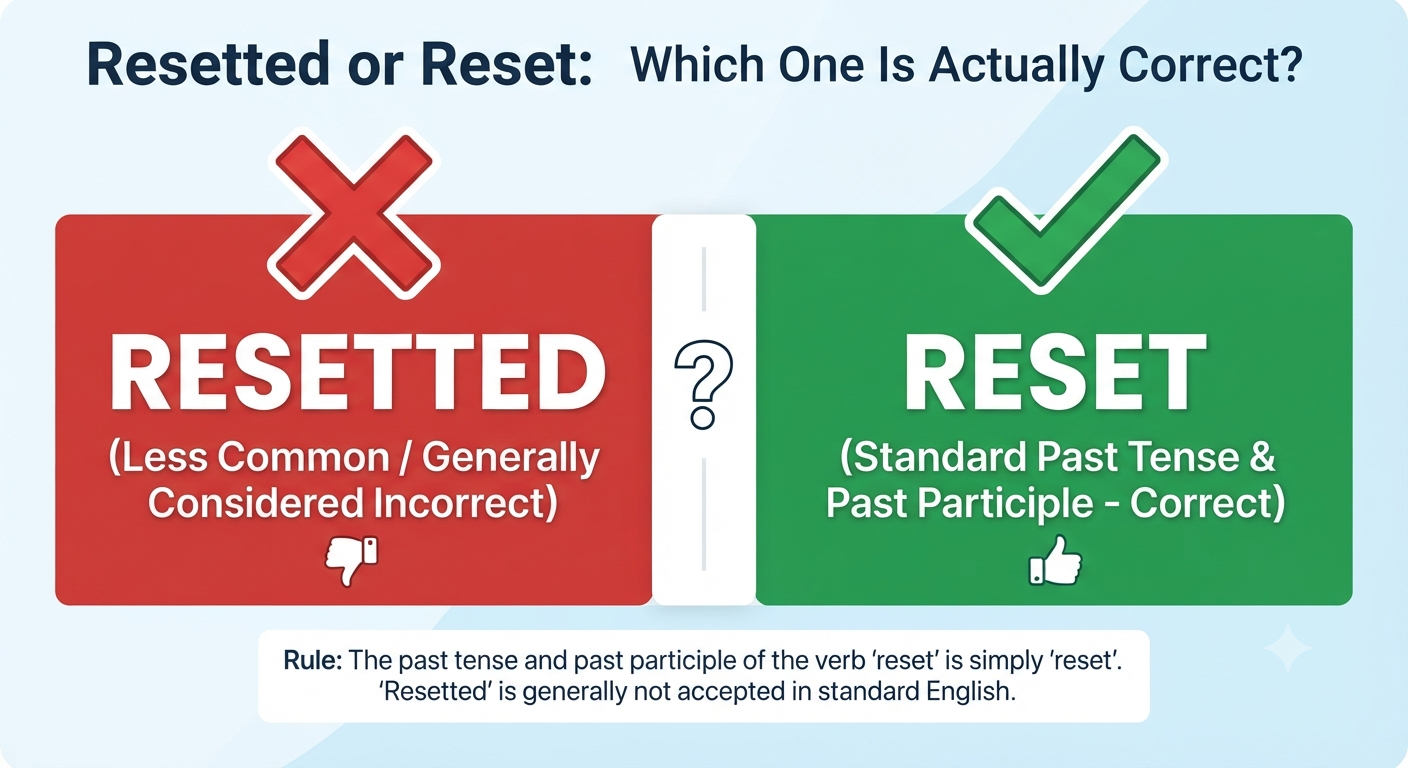
Resetted or Reset: Which One Is Actually Correct?
If you’ve ever typed “I resetted my password” and then paused, wondering if that word even looks right, you’re not alone.
Resetted or Reset is one of those small grammar questions that trips up even confident English speakers. It looks like it should follow the normal rules, but it doesn’t.
This article breaks down exactly why that happens, and gives you a simple way to never get it wrong again.
It’s a tiny detail, but it shows up everywhere. Password reset emails, gaming forums, router manuals, and casual texts all rely on this word constantly, so getting it right actually matters more than it seems at first glance.
Why People Get Confused by Resetted or Reset
Most English verbs form their past tense by adding “-ed.” Walk becomes walked. Jump becomes jumped. So it feels natural to assume reset becomes resetted.
But English has a stubborn group of irregular verbs that refuse to follow this pattern, and reset is one of them.
This mismatch between what feels logical and what’s actually correct is exactly where the confusion starts.
Add in the fact that autocorrect doesn’t always catch it, and a lot of people simply never get corrected. They see “resetted” go unflagged in a text message, assume it must be fine, and keep using it without a second thought.
There’s also a subtler issue at play. Because reset is a compound irregular verb, it doesn’t look like the more familiar irregular verbs people learn early on, like “go” becoming “went” or “eat” becoming “ate.” Those transformations are dramatic and memorable. Reset staying exactly the same is almost too subtle to notice, so the brain defaults to the regular “-ed” pattern instead.
What This Article Will Help You Understand
By the end, you’ll know the correct past tense of reset, how it behaves in different tenses, and how it compares to similar irregular verbs.
You’ll also see real sentence examples across technology, gaming, and everyday texting, so the rule sticks in a practical way rather than as an abstract fact.
What Does Resetted or Reset Mean in Text?
The Simple One-Line Definition
Reset means to set something back to its original or default state, and the correct past tense and past participle of reset is simply “reset” — not “resetted.”
Does Resetted or Reset Always Mean the Same Thing?
The meaning of reset stays consistent whether you’re talking about a device, a password, a game, or a plan. Only the grammar around it changes.
For example, “I reset my router yesterday” uses reset as the past tense of reset. “I have reset my router twice this week” uses it as the past participle of reset. Same word, same spelling, different grammatical role.
This is actually a helpful clue. Since the form never changes, you don’t need to memorize different spellings for different tenses. You just need to remember it stays as “reset” throughout.
Here’s how that plays out across every tense you’re likely to use in daily writing or conversation:
Reset present tense: “I reset my password every few months for security.”
Past tense: “I reset it again yesterday after forgetting the new one.”
Reset continuous form: “I am resetting my email settings right now.”
Past participle: “I have reset this account three times this year alone.”
Notice that the only form that adds letters is the continuous form, “resetting,” because that follows the normal “-ing” rule. The past tense and past participle both stay untouched as “reset,” which is the part people consistently get wrong.
Origin of Resetted or Reset Slang

Calling this “slang” is a bit of a stretch, since reset is standard English rather than internet-born shorthand. But the confusion around is resetted a word has definitely grown alongside digital communication.
Which Platforms Made It Popular?
The rise of texting culture, group chats, and app notifications means people type the word “reset” constantly — resetting passwords, resetting game progress, resetting router settings.
That frequency is exactly why small errors like “resetted” spread. When a word gets typed thousands of times a day across WhatsApp chat words, comment sections, and support tickets, occasional misspellings start to look normal, even though they aren’t.
Snapchat Instagram slang trends also play a role here, even indirectly. Fast, informal typing habits built on these platforms tend to spill over into other kinds of writing, including emails and school assignments where accuracy actually counts. The casual tone of casual texting language is great for speed, but it can quietly train people toward the wrong habit if nobody ever points it out.
Who Uses Resetted or Reset the Most?
Gamers, tech support threads, and anyone dealing with reset password grammar situations use this word constantly. Non-native English learners also encounter it often, since English irregular verbs are notoriously tricky to pick up.
It’s genuinely one of the more common grammar mistakes with reset among English learners, right alongside similar irregular verbs like set, cut, put, and shut.
Customer support teams run into this constantly too. Anyone writing troubleshooting steps for reset password grammar issues has probably typed the word dozens of times in a single week, which makes it worth getting exactly right, especially since these instructions often get copied and shared as templates.
Resetted or Reset vs Similar Slang Terms
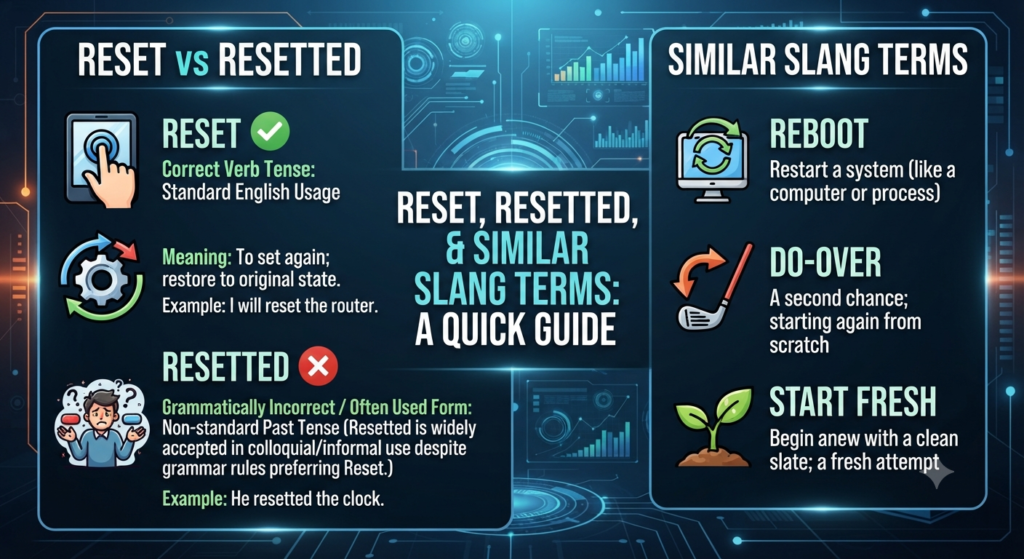
Quick Comparison Table
The table below shows how reset compares to other compound irregular verbs that follow the same no-change pattern.
| Base Verb | Past Tense | Past Participle | Regular or Irregular |
|---|---|---|---|
| Reset | Reset | Reset | Irregular |
| Set | Set | Set | Irregular |
| Cut | Cut | Cut | Irregular |
| Put | Put | Put | Irregular |
| Hit | Hit | Hit | Irregular |
| Walk | Walked | Walked | Regular |
Key Differences Explained
Notice the pattern among set cut put shut hit — none of them change form in the past tense. Reset simply inherits this behavior because it’s built from the root word “set.”
This is a great example of verb morphology English learners can lean on. Once you know that “set” stays the same in every tense, you automatically know “reset,” “upset,” and “onset”-related verbs behave the same way.
Compare that to regular vs irregular verbs like “walk” or “text,” which happily take on “-ed” endings without any trouble. Reset simply isn’t part of that group, no matter how tempting it feels to add the ending.
This connects to a broader idea in verb tense indicators: irregular verbs often cluster in families based on shared roots. Once you spot the family reset belongs to, the whole group becomes predictable instead of confusing. It’s a small mental shortcut, but it removes a surprising amount of guesswork from everyday writing.
There’s also a quick note worth making about reset pronunciation and reset etymology, since both help explain why the word behaves the way it does. Reset traces back to “set,” a verb with Old English roots that has stayed irregular for centuries. The pronunciation stress falls on the second syllable, re-SET, which stays consistent no matter which tense you’re using.
Real Conversation Examples of Resetted or Reset

Between Friends
“Hey, I reset my Wi-Fi router last night and it fixed the lag.”
“Same here, I reset my phone settings after the update messed things up.”
Both examples use the correct form naturally, exactly the way it would sound in casual online messaging culture.
In a Flirty Context
“I feel like we reset things after that talk, and honestly, I like where we’re at now.”
Here reset carries an emotional meaning — starting fresh in a relationship or friendship — but the grammar rule doesn’t change one bit. It’s still reset, not resetted, even in a warmer, more personal message.
In a Group Chat
“Someone reset the group chat theme again lol”
“Wait who reset the shared playlist?? It’s empty now”
These quick, casual messages show exactly how reset shows up in real short form messaging, where speed matters and grammar habits form fast, for better or worse.
It’s also worth looking at a couple of examples outside of pure texting, since reset shows up constantly in gaming and tech contexts too. A reset technology example might read: “The technician reset the server overnight, so everything should be running smoothly again by morning.” In gaming, you might see: “I reset my save file because I wanted to try a different character build from the start.” Both sentences use the same unchanged form, no matter how different the subject matter is.
Is Resetted or Reset Rude, Polite, or Flirty?
This section isn’t about tone so much as accuracy, but the way you use the word does affect how a message lands.
When It Feels Friendly
Using reset correctly in a casual message, like “just reset my password, all good now,” reads as clear and effortless. It doesn’t draw attention to itself, which is exactly what good grammar should do.
When It Can Feel Too Forward
Using “resetted” repeatedly, especially in professional messages or modern internet slang-heavy group chats, can come across as careless. It’s not rude exactly, but it can make a message look rushed or less polished, particularly in formal emails or technology write-ups like troubleshooting guides.
This matters more in workplace settings than in casual chats with friends. A manager reading “I resetted the server twice” might not say anything, but small grammar slips like this can quietly shape how careful or detail-oriented your writing seems, especially in written reports where precision counts.
How to Respond to Resetted or Reset
Simple Replies
If someone tells you “I reset my account,” a natural reply is “Nice, did that fix it?” or “Good call, that usually works.”
Playful Replies
For a lighter tone, something like “Look at you, resetting things like a tech wizard” keeps the conversation fun while quietly reinforcing the correct grammar form.
When NOT to Use Resetted or Reset
Avoid “resetted” entirely in formal writing, resumes, technical documentation, or anywhere English learners grammar tips matter, such as classroom assignments or professional emails.
It’s also worth avoiding in customer support scripts, app instructions, or any reset in a sentence example meant to teach others, since incorrect grammar there can spread the same confusion further.
Casual texting with close friends is really the only place where a slip like “resetted” won’t raise an eyebrow. Even then, building the habit of using the correct form pays off, since it carries over automatically into emails, job applications, and school assignments without you having to think twice about it.
FAQ
Is resetted a real word?
No. Resetted is a common mistake, but it isn’t recognized as standard English. Reset is correct as both the reset present tense and past tense form.
What is the correct past tense of reset?
The correct past tense is simply “reset.” There’s no added “-ed,” which makes it one of the more confusing English irregular verb list entries for learners.
Does Merriam-Webster or Oxford list resetted as correct?
No major dictionary, including Merriam-Webster reset, Cambridge Dictionary reset, or Oxford English Dictionary reset entries, lists “resetted” as a valid form. All confirm reset stays unchanged across tenses.
Why does reset not follow normal grammar rules?
Reset is built from “set,” which has always been irregular. This is a classic case of reset grammar rule behavior being inherited directly from its root verb.
How do I remember the correct form of reset?
Think of similar irregular verbs like set, cut, put, and hit. If none of those take an “-ed” ending, reset won’t either. This simple mental checklist covers most verb conjugation reset situations you’ll run into.
Conclusion
The short answer to Resetted or Reset is straightforward: reset is correct, and resetted isn’t a recognized word in standard English.
It feels like it should take an “-ed,” but because it’s rooted in “set,” it stays the same across present, past, and past participle forms.
Once that clicks, you’ll never second-guess yourself again, whether you’re texting a friend, writing a support email, or filling out a report.
If you found this useful, you might also enjoy a deeper guide on other irregular verb list entries that trip people up in everyday writing, like set, cut, and put.