
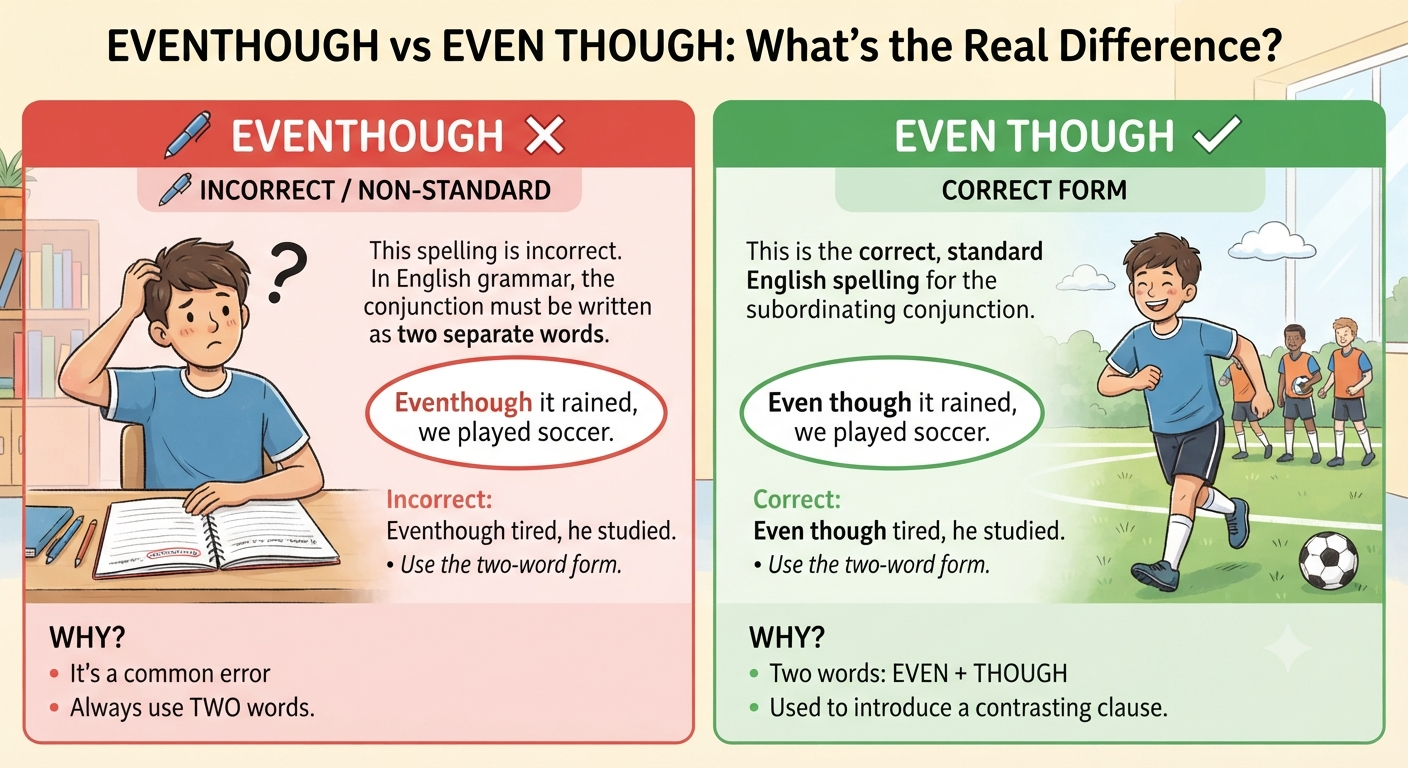
Eventhough vs Even Though: What’s the Real Difference?
If you’ve ever paused mid-text wondering whether to type “eventhough” or “even though,” you’re not alone.
Eventhough vs Even Though is one of those tiny writing puzzles that trips up even confident writers. It looks harmless, but it shows up everywhere — texts, emails, captions, even school essays.
This article breaks down exactly what’s going on, why the confusion exists, and how to get it right every single time.
Why People Get Confused by Eventhough vs Even Though
Most of the confusion comes down to speech. When people talk fast, “even though” blends together and sounds like one word.
That’s called phonetic elision — where spoken sounds merge — and it’s a big reason so many people end up typing “eventhough” without even noticing.
Add autocorrect spelling errors and predictive text mistakes into the mix, and the wrong version starts to feel normal, even though it isn’t correct.
What This Article Will Help You Understand
By the end, you’ll know the correct spelling of even though, when “eventhough” pops up in real conversations, and how to avoid the common grammar mistake in formal writing.
We’ll also look at real texting examples, a comparison table, and answers to the questions people ask most.
What Does Eventhough vs Even Though Mean in Text?
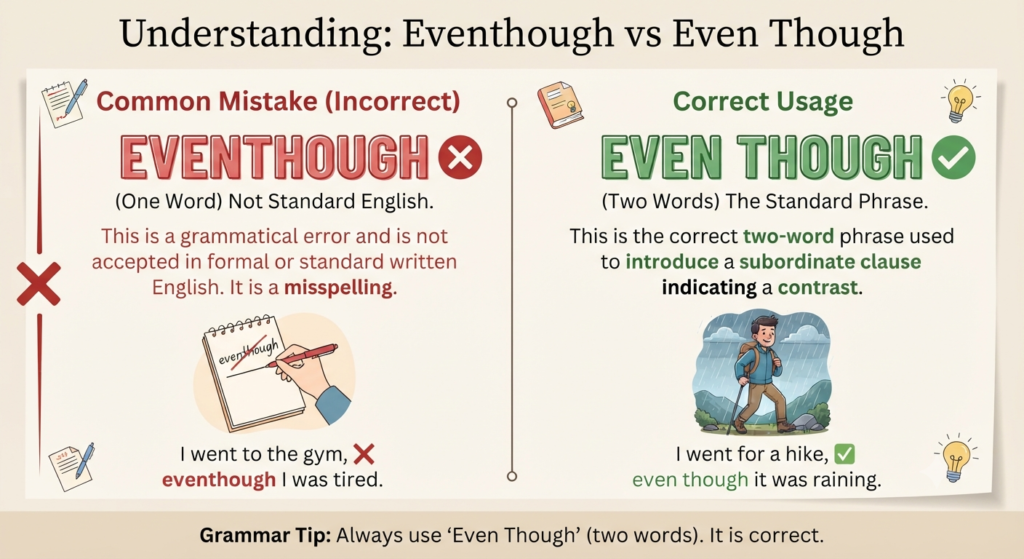
The Simple One-Line Definition
Even though is a subordinating conjunction used to introduce a contrast or concession between two ideas — for example, “I went for a run even though it was raining.”
Eventhough, on the other hand, isn’t a real word. It’s simply a nonstandard word form — a word fusion error where two separate words get squished into one.
Does Eventhough vs Even Though Always Mean the Same Thing?
In terms of meaning, yes. When someone types “eventhough” in a text, they almost always intend the exact same thing as “even though.”
The difference isn’t about meaning — it’s purely a spelling mistake. Think of it the same way you’d think of “alot” instead of “a lot.” The intended message is identical; the form is just wrong.
That said, context matters. In casual texting culture, nobody’s going to think less of you for typing “eventhough” quickly. In an email to your boss or a college essay, it reads as sloppy.
Origin of Eventhough vs Even Though Slang
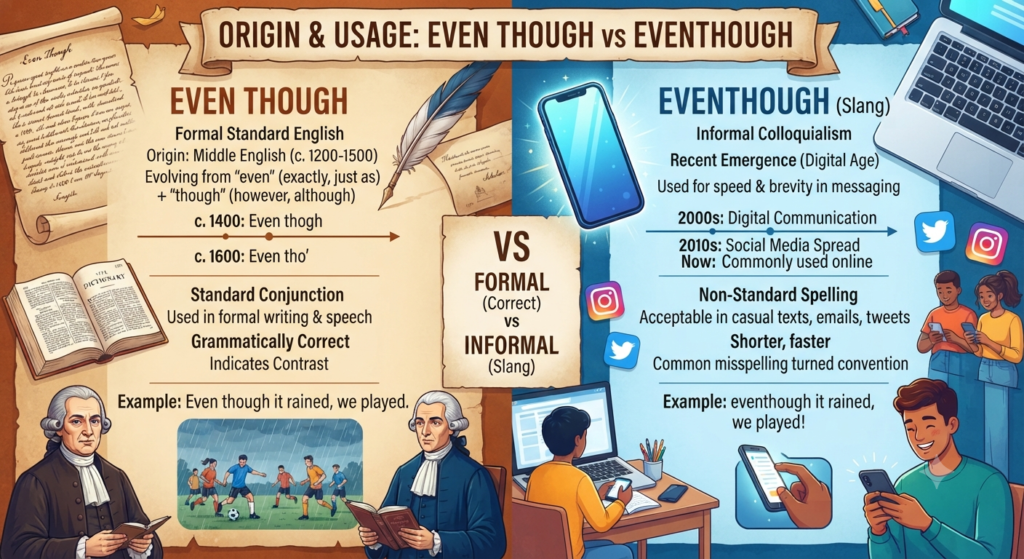
Which Platforms Made It Popular?
Calling “eventhough” slang is a bit of a stretch — it’s really a spelling shortcut that spread through digital communication rather than a term that was invented on purpose.
It shows up constantly in casual texting language, especially on WhatsApp chat words, Snapchat Instagram slang, and comment sections where people type fast and don’t proofread.
Texting culture rewards speed over accuracy, so short form messaging habits like dropping the space between “even” and “though” became common. It’s less a trend and more a byproduct of how quickly we all type on phones now.
Who Uses Eventhough vs Even Though the Most?
You’ll see “eventhough” most often among younger texters immersed in modern internet slang and fast-paced group chats, where Gen Z slang and abbreviations dominate the conversation.
It also shows up a lot in DMs, comment replies, and quick voice-to-text messages, where online messaging culture favors speed over spelling.
Older or more formal writers tend to catch it faster, since they’re more used to writing complete sentences slowly and reviewing them before hitting send.
Eventhough vs Even Though vs Similar Slang Terms
Quick Comparison Table
Here’s a table showing how “even though” compares with similar contrast words people often mix up.
| Term | Correct Form? | Meaning | Common Use |
|---|---|---|---|
| Even though | Yes | Introduces a contrast despite a fact | Formal and casual writing |
| Eventhough | No | Misspelling of “even though” | Texting, fast typing |
| Although | Yes | Very similar to even though, slightly more formal | Essays, articles |
| Even if | Yes | Introduces a hypothetical contrast, not a fact | Conditional statements |
| Despite | Yes | Followed by a noun, not a full clause | Formal writing |
| While | Yes | Can show contrast or simultaneous action | Both formal and casual |
Key Differences Explained
The although vs even though debate is mostly about tone. “Although” leans slightly more formal, while “even though” feels a touch more conversational, though both are grammatically identical in function.
The even if vs even though distinction is more important. “Even though” refers to something that is true right now — “Even though it’s cold, I’m going outside.” “Even if” refers to something hypothetical — “Even if it’s cold, I’ll go outside.”
“Despite” works differently too. It’s usually followed by a noun or gerund, not a full dependent clause, so “despite the rain” works, but “despite it was raining” does not.
Real Conversation Examples of Eventhough vs Even Though
Between Friends
Texting a friend: “Eventhough I’m tired, let’s still go out tonight.”
Here, the message is casual and low-stakes. Nobody’s grading grammar in a group chat, so the misspelling barely registers.
In a Flirty Context
Texting a crush: “Eventhough you took forever to reply, I’m still smiling at my phone.”
In flirty texting, small spelling slips like this often go unnoticed because the tone and playfulness carry the message more than the grammar does.
In a Group Chat
Group chat message: “Eventhough half of us bailed, tonight was actually kind of fun.”
In fast-moving group chats, short form messaging habits take over completely, and correcting spelling would almost feel out of place.
Is Eventhough vs Even Though Rude, Polite, or Flirty?
When It Feels Friendly
Using “eventhough” in a casual text rarely comes across as rude. It’s simply part of casual texting language, the same way lowercase letters or missing punctuation are.
Friends and close contacts usually read right past it, focusing on the meaning rather than the spelling.
When It Can Feel Too Forward
The word itself isn’t flirty or aggressive, but the sentence around it can be. “Eventhough I just met you, I already like talking to you” carries a bold, direct tone regardless of spelling.
In these cases, it’s the sentiment — not the misspelling — that shifts the tone. The spelling error just tags along for the ride.
How to Respond to Eventhough vs Even Though
Simple Replies
If someone texts you using “eventhough,” you don’t need to correct them. A normal reply works fine, like “Yeah, same here” or “That makes sense.”
Correcting someone’s spelling in a personal text usually feels unnecessary and a little awkward, unless they specifically ask.
Playful Replies
If you want to keep things light, you can gently tease it: “Eventhough, huh? Living dangerously with that spacebar today.”
This works especially well in flirty or joking conversations, where a light callout can actually build rapport instead of feeling critical.
When NOT to Use Eventhough vs Even Though
Skip “eventhough” entirely in formal vs informal writing situations where credibility matters — resumes, cover letters, official emails, and reports.
Business communication grammar expectations are strict, and a single spelling mistake like this can undercut how competent your message looks, even if the content is solid.
Academic writing errors, including this one, tend to stand out to teachers and professors, since English spelling errors like fused words are considered basic mistakes to avoid.
Even in less formal writing, like a blog post or a professional social media caption, sticking with the correct two-word form keeps your writing looking clean and intentional.
FAQ
Is “eventhough” ever considered correct?
No. Dictionary definition sources like Merriam-Webster grammar rules, Oxford dictionary spelling, and Cambridge dictionary usage all confirm that “even though” must be written as two separate words.
Why does spellcheck sometimes miss it?
Some spellcheck tools and Grammarly spelling check features catch it instantly, but others may miss it depending on context, especially in fast typing or voice-to-text apps.
What’s the easiest way to remember the correct spelling?
A simple mnemonic device helps: think of “even” and “though” as two separate ideas being compared, just like “even” and “so” are always separate words.
Does “eventhough” have Middle English origins?
No. English language history shows that “even though” developed naturally as two words used together for contrast conjunctions, unlike genuine compound words with Middle English origins.
Is it okay to use “eventhough” in texting?
Yes, in casual conversations it’s generally fine. But once you shift into professional writing, essays, or any writing meant to reflect your writing credibility, always use the correct two-word form.
Conclusion
At the end of the day, Eventhough vs Even Though isn’t really a battle between two valid options — it’s a reminder that quick typing habits can quietly slip into places they don’t belong.
For texting, casual chats, and quick replies, nobody’s going to blink twice. But for anything formal, sticking with the correct subordinating conjunction spelling keeps your writing sharp and easy to trust.
Once you know the difference, it becomes second nature, and you’ll likely start noticing “eventhough” everywhere else it doesn’t belong.
If you found this useful, you might also enjoy a deeper look at other contrast conjunctions like “although,” “despite,” and “while,” and how to use each one with confidence in both formal and casual writing.