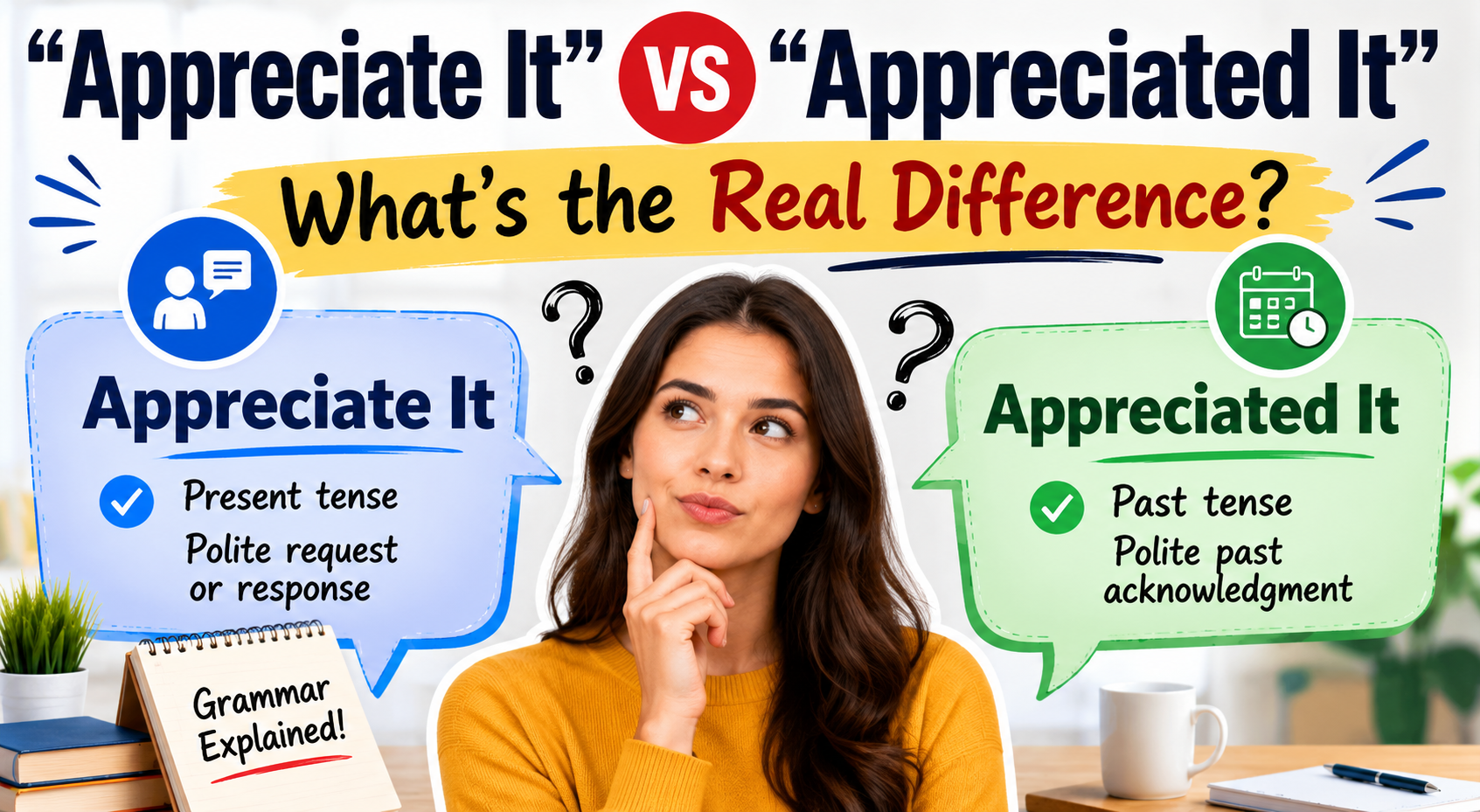
Appreciate It” vs “Appreciated It : What’s the Real Difference?
“Appreciate It” vs “Appreciated It” trips up more people than you’d expect.
You send a text, someone helps you out, and you type “appreciate it.” Then five minutes later you’re wondering if you should’ve said “appreciated it” instead.
It seems like a tiny detail. But that one-letter difference changes the tone, the timing, and sometimes even how sincere your thank you sounds.
Why People Get Confused by “Appreciate It” vs “Appreciated It”
Most of the confusion comes down to verb conjugation. English has present simple vs past simple forms, and gratitude phrases are no exception.
“Appreciate” is happening now. “Appreciated” already happened. That sounds simple on paper.
But in real texting culture, people mix tenses without thinking twice. Nobody’s grammar-checking a text to their roommate.
So the lines blur, especially in casual conversational English where speed matters more than precision.
What This Article Will Help You Understand
By the end of this, you’ll know exactly when to use each phrase, why the tense consistency actually matters, and how each version lands differently depending on who’s reading it.
We’ll also cover how these phrases show up in professional email etiquette, online messaging culture, and even flirty group chats. Yes, really.
What Does “Appreciate It” vs “Appreciated It” Mean in Text?
At the core, both phrases express thankfulness in communication. The difference is timing, not meaning.
The Simple One-Line Definition
“Appreciate it” means you’re thankful right now, in the moment. “Appreciated it” means you were thankful after something already happened, often used when reflecting back on it.
Think of it as present tense gratitude versus past tense gratitude. One is immediate. The other is reflective.
Does “Appreciate It” vs “Appreciated It” Always Mean the Same Thing?
Not quite. “Appreciate it” is your go-to for quick, in-the-moment thanks, like replying to a text where someone just sent you something.
“Appreciated it” tends to show up when you’re talking about a past event. Maybe a coworker helped you last week, and you’re bringing it up again.
This is where reflective vs immediate gratitude really comes into play. The tense you choose tells the other person exactly when your gratitude happened.
Using the wrong one isn’t a grammar crime, but it can create a slightly odd or overly formal vibe in a casual chat.
Origin of “Appreciate It” vs “Appreciated It” Slang
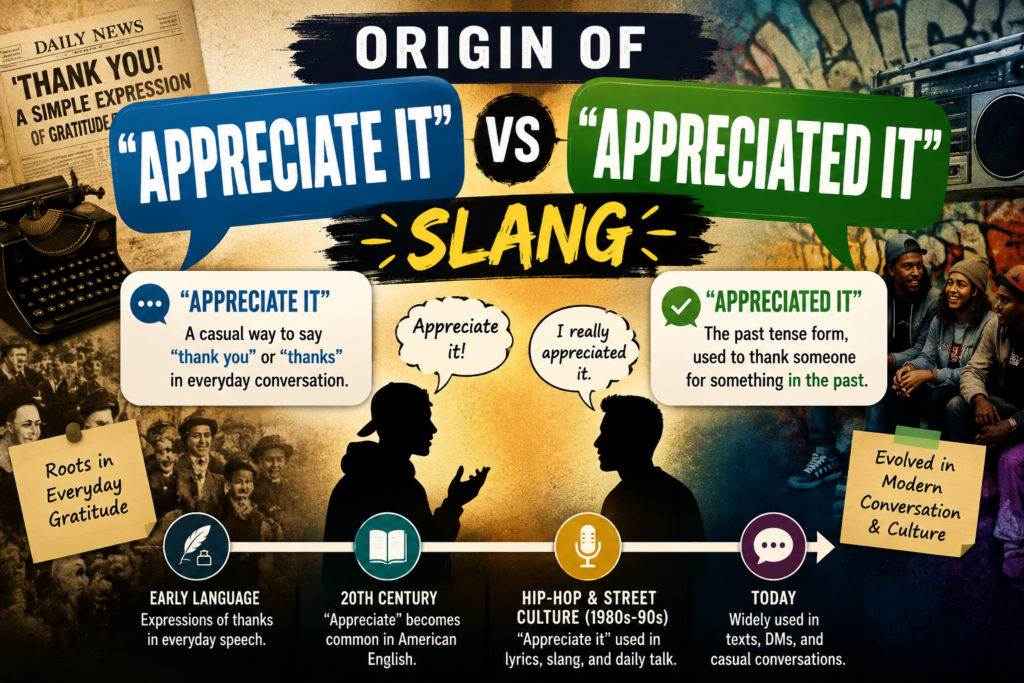
Neither phrase started as slang exactly. They’re standard English, but their casual, clipped usage online has basically turned them into shorthand.
Which Platforms Made It Popular?
Texting culture, WhatsApp chat words, and short form messaging apps are where these phrases really took off in their abbreviated forms.
You’ll also see them constantly in comment sections, replies, and captions across Snapchat Instagram slang style exchanges. People drop the “I” and “you” entirely: just “appreciate it” on its own line.
Digital communication rewards brevity, so full sentences like “I really appreciate that you did this” get trimmed down fast.
Who Uses “Appreciate It” vs “Appreciated It” the Most?
Younger users lean heavily on “appreciate it” as a catch-all response, part of the broader wave of Gen Z slang and modern internet slang.
Older users or professionals writing a thank-you email are more likely to reach for “appreciated it” or fuller phrases like “I appreciated your help” when referencing something specific that already happened.
Workplace settings tend to favor whichever form fits the tense consistency of the surrounding sentence, which we’ll get into shortly.
“Appreciate It” vs “Appreciated It” vs Similar Slang Terms
These two phrases don’t exist in a vacuum. There’s a whole family of thank you variations floating around.
Quick Comparison Table
Here’s a simple breakdown of how these phrases stack up against each other in tone and timing.
| Phrase | Tense | Common Use | Tone |
|---|---|---|---|
| Appreciate it | Present | Immediate thanks | Casual, quick |
| Appreciated it | Past | Reflecting on past help | Slightly more formal |
| Much obliged | Present | Polite, old-fashioned thanks | Formal, sometimes playful |
| Grateful for it | Present | Emotional emphasis | Warm, sincere |
| Means a lot | Present | Emotional weight | Personal, heartfelt |
| Can’t thank you enough | Present | Strong gratitude | Enthusiastic, sincere |
Key Differences Explained
“Much obliged” carries an old-school, almost theatrical politeness. People often use it jokingly now rather than seriously.
“Grateful for it” and “means a lot” lean into emotional tone in language, adding warmth that a plain “appreciate it” doesn’t always carry.
“Can’t thank you enough” is the most intense of the bunch. It signals gratitude that feels bigger than a simple favor.
Compared to all of these, “appreciate it” and “appreciated it” stay neutral. They’re the default, low-effort polite conversational phrases most people reach for first.
Real Conversation Examples of “Appreciate It” vs “Appreciated It”
Seeing these phrases in context makes the tense difference much clearer.
Between Friends
Friend: “Sent you the notes from class.” You: “Appreciate it, saved my life today.”
Here, the help just happened, so present tense fits naturally.
Now imagine this the next day: “Hey, I appreciated it, those notes actually helped me pass.” That’s reflective, referencing something already done.
In a Flirty Context
“You didn’t have to walk me to my car, but I appreciate it.”
This version feels warm and immediate, almost like a soft acknowledgment in the moment.
Compare that to: “I appreciated it more than you know, that night meant a lot.” This past-tense version feels more emotionally loaded, like you’re reflecting on something meaningful after the fact.
In a Group Chat
Someone shares event photos in the chat. A quick reply might be: “Appreciate it, these are great.”
Later, someone might bring it up again: “Just saw these again, appreciated it when you sent them over.”
Both work. The difference is purely about when the gratitude is being expressed relative to the action.
Is “Appreciate It” vs “Appreciated It” Rude, Polite, or Flirty?
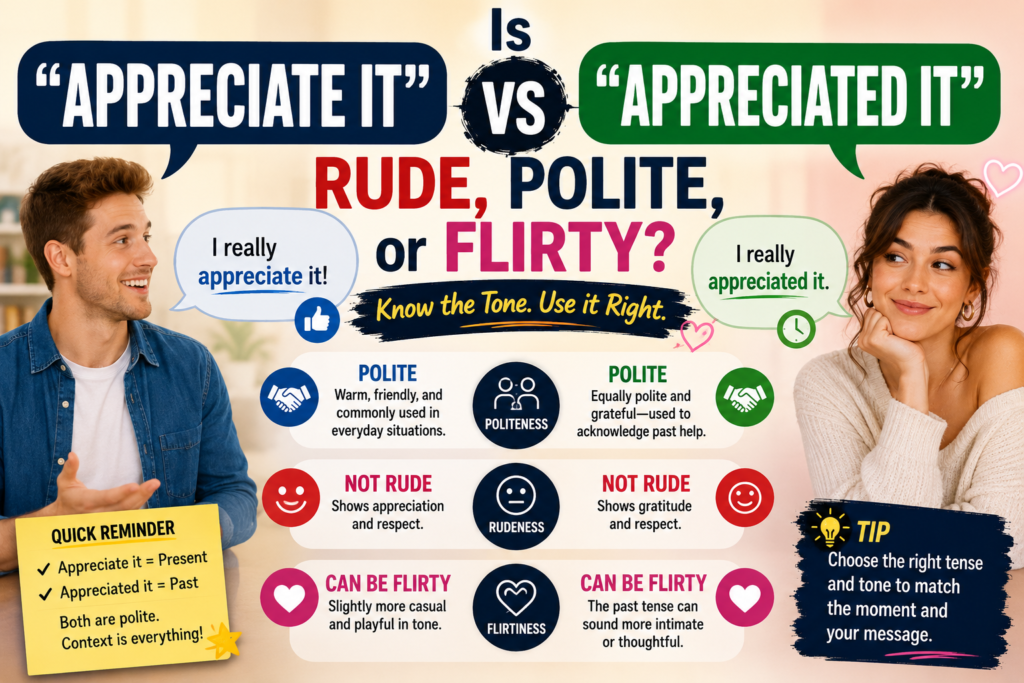
Neither phrase is inherently rude. Both sit comfortably in the range of polite expressions in English.
When It Feels Friendly
Used right after someone does something for you, “appreciate it” reads as warm, casual, and genuine. It’s short, but it doesn’t feel dismissive.
In a thank-you email to a coworker, “I appreciate your quick response” comes across as professional and polite without sounding stiff.
When It Can Feel Too Forward
Things shift slightly in flirty contexts. Saying “appreciated it” about a past moment can sound like you’re dwelling on something, which might come across as too intense too soon.
In workplace communication tone, using “appreciated it” without context can also feel a little vague, like you’re referencing something the other person may not immediately recall.
Context always does the heavy lifting here. The phrase itself rarely causes offense.
How to Respond to “Appreciate It” vs “Appreciated It”
Replying doesn’t need to be complicated. Most responses fall into two buckets: simple and playful.
Simple Replies
“No problem.” “Anytime.” “Of course, glad I could help.”
These work fine in both formal correspondence tone and casual chats. They’re short, sincere, and don’t overdo it.
Playful Replies
“Don’t mention it, you owe me one though.” “Appreciate you appreciating me.” “That’s what I’m here for.”
These fit better in friendly or flirty exchanges, especially over text where emotional tone in language carries more weight than the actual words used.
When NOT to Use “Appreciate It” vs “Appreciated It”
Skip both phrases when a situation calls for more detail. A vague “appreciate it” after major help, like someone covering rent or supporting you through something hard, can feel underwhelming.
In business correspondence language, avoid using “appreciated it” without specifying what you’re referring to. It can confuse the reader, especially in longer email threads.
Also avoid mixing tenses within the same message. Writing “I appreciate it, and I appreciated your help yesterday” in the same breath can read as inconsistent, even if each part is technically correct.
If you’re aiming for a formal, polished tone, phrases like “grateful for your assistance” or “thank you for your continued support” often fit better than the casual shorthand versions.
FAQ
Is “appreciate it” grammatically correct in every sentence?
Yes, as long as you’re referring to something happening now or something ongoing. It follows standard subject-verb agreement, so it works fine in casual texts and emails alike.
Can I use “appreciated it” in a formal thank-you email?
Yes, especially when referencing a specific past action, like “I appreciated your feedback on the report.” It fits naturally into professional email etiquette.
Does “appreciate it” sound too casual for work emails?
Not necessarily. Many professionals use it daily, though pairing it with more detail, like “I appreciate your quick turnaround,” keeps it appropriately professional.
Why do people drop “I” and just say “appreciate it”?
This is common in short form messaging and reflects how native English usage patterns naturally shorten sentences in casual digital spaces without losing meaning.
Is one version more polite than the other?
Not inherently. Politeness depends more on context and tone than tense. Both are considered standard polite conversational phrases in everyday English.
Conclusion
At the end of the day, “Appreciate It” vs “Appreciated It” really just comes down to timing. One lives in the present moment, the other looks back on something already done.
Neither is more correct than the other, and neither is rude by default. Once you understand the tense difference, choosing between them becomes second nature.
Pay attention to context, keep your tenses consistent, and you’ll never second-guess your gratitude again.
If you found this useful, you might also enjoy a deeper look at common grammar mistakes people make in everyday texting and casual writing.