
“Proud for You” vs “Proud of You”: What’s the Real Difference?
Two little prepositions. One giant emotional difference.
“Proud for you” vs “Proud of you“ is one of those English phrase pairs that looks almost identical on paper but lands completely differently in a real conversation. Swap the wrong word in and your text can suddenly sound distant, or even slightly off, when you meant it as the warmest compliment you could give.
If you’ve ever paused mid-text wondering which one to send, you’re not overthinking it. This is a genuinely tricky corner of preposition usage, and even native speakers mix it up more than they’d admit.
Why People Get Confused by “Proud for You” vs “Proud of You”
The confusion comes from the fact that both phrases are congratulatory. Both are warm. Both show up in texts, comments, and captions after someone shares good news.
But proud of you and proud for you point in two different emotional directions. One is about the person’s character or effort. The other is about their circumstances or luck.
English doesn’t always make that distinction obvious, which is exactly why so many people use the two interchangeably without realizing there’s a grammar rule quietly running underneath.
What This Article Will Help You Understand
By the end of this guide, you’ll know exactly when to use each phrase, why the prepositions in English matter here more than usual, and how native speakers actually use these lines in texting, DMs, and everyday conversation.
We’ll also cover real examples, a comparison table, reply ideas, and situations where you might want to avoid one phrase entirely.
What Does “Proud for You” vs “Proud of You” Mean in Text?
The Simple One-Line Definition
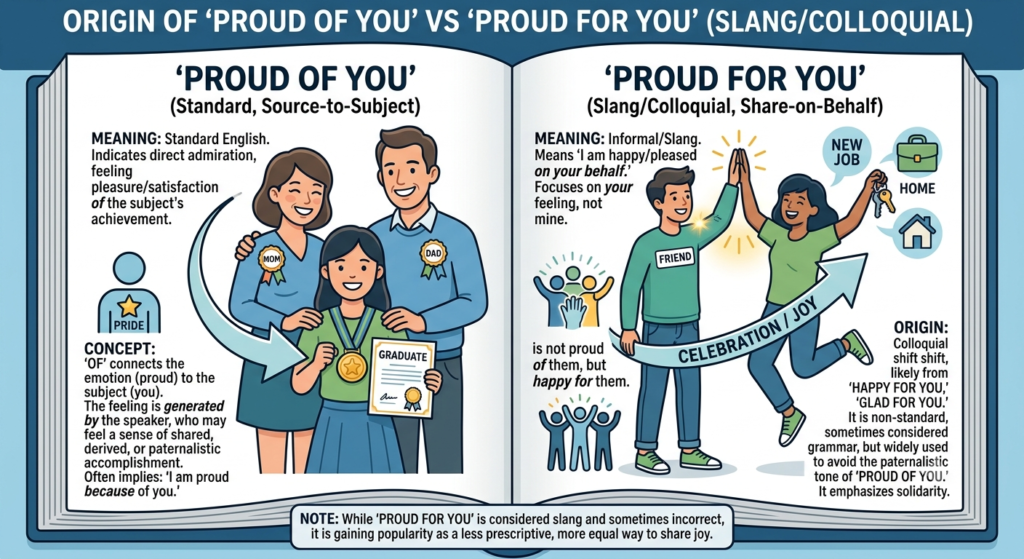
Proud of you means you admire something the person did, earned, or became through their own effort. Proud for you means you’re happy about something good that happened to them, even if they didn’t directly cause it.
That’s the whole rule in a sentence. Everything else is just examples of it in action.
Does “Proud for You” vs “Proud of You” Always Mean the Same Thing?
Not quite, even though people often treat them as swappable.
“I’m proud of you for finishing the marathon” praises the achievement itself. It recognizes discipline, effort, and admiration vs happiness tips clearly toward admiration.
“I’m proud for you that the surgery went well” leans toward relief and shared happiness about an outcome, not an accomplishment. It’s closer to happy for you or thrilled for you than a compliment on someone’s skill.
So while both are kind, the emotional direction behind each phrase is genuinely different, even when the situations that trigger them look similar from the outside.
Origin of “Proud for You” vs “Proud of You” Slang
Which Platforms Made It Popular?
Neither phrase is slang in the traditional sense. Both come from standard English grammar rules around collocation in grammar, where certain verbs pair naturally with certain prepositions.
What’s changed is where these phrases get used. Texting culture, Instagram captions, and WhatsApp chat words have made short congratulatory messages far more common than they used to be, so people now type “proud of you” and “proud for you” dozens of times a week without thinking twice.
Digital communication favors short, punchy phrases, and this pair fits perfectly into that style. It’s brief, it’s warm, and it works in a comment section just as well as a heartfelt paragraph.
Who Uses “Proud for You” vs “Proud of You” the Most?
Parents texting kids about grades, job offers, or milestones use proud of you constantly. It’s practically the definition of parent to child phrases and achievement recognition language.
Friends supporting each other through breakups, new jobs, or health news lean more on proud for you, especially when the good news wasn’t something the friend “worked for” in a traditional sense, like inheriting a windfall or finally getting good medical results.
Younger texters on Snapchat and Instagram tend to blur the two together in casual chats, while people writing more formal messages, like a congratulations phrases email or LinkedIn comment, are more careful to pick the technically correct one.
“Proud for You” vs “Proud of You” vs Similar Slang Terms
Quick Comparison Table
Here’s a quick side-by-side look at how these phrases compare to similar supportive language you might use instead.
| Phrase | Main Focus | Best Used When | Tone |
|---|---|---|---|
| Proud of you | Effort, skill, character | Someone achieved or earned something | Admiring, warm |
| Proud for you | Outcome, good fortune | Something good happened to someone | Happy, relieved |
| Happy for you | Shared joy | General good news, no judgment involved | Light, casual |
| Thrilled for you | Big excitement | Major life news | Enthusiastic |
| Congrats | Quick acknowledgment | Any positive event | Neutral, brief |
Key Differences Explained
The biggest difference lies in correct preposition usage. “Of” connects to a source or cause, so “proud of you” ties the pride directly to the person as the cause of the good outcome.
“For” connects to a beneficiary, which is why “proud for you” treats the person as someone benefiting from good news rather than the one who created it.
Happy for you and thrilled for you skip the pride angle entirely and focus purely on shared happiness, which makes them safer choices when you’re not sure the person actually “earned” the outcome.
This is one of those spots where native speaker intuition kicks in automatically, even if most people couldn’t explain the rule out loud.
Real Conversation Examples of “Proud for You” vs “Proud of You”
Between Friends
Friend: “I finally passed my bar exam!!” You: “I’m SO proud of you. You worked so hard for this.”
Friend: “The doctor said the tumor is benign.” You: “I’m so proud for you, that’s such a relief.”
In a Flirty Context
Them: “I just got promoted to manager 👀” You: “Look at you. Proud of you, and honestly kind of attracted to your ambition rn.”
Them: “My ex finally left me alone after I set boundaries.” You: “Proud of you for that. Setting boundaries is hot, not gonna lie.”
In a Group Chat
Group member: “Update: I got the apartment!!” Friend 1: “Proud for you!! Been rooting for this.” Friend 2: “Proud OF you too, you handled that lease negotiation like a pro.”
Is “Proud for You” vs “Proud of You” Rude, Polite, or Flirty?

When It Feels Friendly
Both phrases are almost always read as kind. Emotional warmth in language is the default tone here, so there’s very little risk of either phrase sounding cold in a normal supportive message.
“Proud of you” tends to feel slightly more personal and intimate, since it directly credits the other person’s character or effort.
When It Can Feel Too Forward
The only time this gets tricky is with people you’re not close to. Saying “proud of you” to a coworker you barely know can feel oddly parental or overly familiar, almost like you’re evaluating them.
In those situations, congratulatory expressions like “congrats” or “so happy for you” are safer, since they skip the personal judgment that “proud” carries.
How to Respond to “Proud for You” vs “Proud of You”
Simple Replies
“Thank you, that really means a lot.”
“I appreciate you saying that.”
“Means the world coming from you.”
Playful Replies
“Stop, you’re gonna make me blush.”
“I know, I know, I’m kind of a big deal now.”
“Proud of me? Wait till you hear what’s next.”
When NOT to Use “Proud for You” vs “Proud of You”
Avoid “proud of you” when the good news wasn’t really the person’s doing, like winning a raffle or receiving an inheritance. It can accidentally sound like you’re crediting effort that wasn’t there.
Avoid “proud for you” when someone genuinely worked hard for an achievement, since it can undersell their effort by framing it as luck instead of skill.
Skip both phrases with strangers, distant coworkers, or professional contacts where formal vs casual speech matters. A simple “congratulations” is usually the safer, more neutral choice in those settings.
FAQ
Is “proud for you” grammatically correct?
Yes. It’s correct English grammar, and it’s commonly used when celebrating good outcomes rather than earned achievements. It just carries a different emotional meaning than “proud of you.”
What’s the main difference between proud of and proud for?
“Of” links pride to the person’s own effort or character. “For” links pride to something good happening to them, regardless of whether they caused it.
Can I use “proud of you” for something that wasn’t an achievement?
You can, but it may sound slightly off if there was no real effort involved. In those cases, “happy for you” or “proud for you” usually fits better.
Is “proud of you” too intimate for a coworker?
It can be, especially with someone you don’t know well. A neutral option like “congrats” or “great news” avoids any awkwardness.
Which phrase is more common in texting?
“Proud of you” is used more often overall, largely because achievements and milestones get shared more frequently than pure luck-based good news.
Conclusion
“Proud for you” vs “proud of you” isn’t just a grammar technicality, it’s a small choice that shapes how supportive your message actually feels.
Use “of” when you’re celebrating someone’s effort, skill, or growth. Use “for” when you’re celebrating something good that happened to them.
Once you see the pattern, you’ll never second-guess the text again.
If you enjoyed untangling this one, you’ll probably like a closer look at “happy for you” vs “happy with you,” another pair that trips people up in almost the exact same way.