Adapter vs Adaptor: What’s the Real Difference?
If you’ve ever typed Adapter vs Adaptor into a search bar mid-sentence, you’re not alone.
It’s one of those word pairs that looks like a typo no matter which way you spell it. You write “adaptor,” stare at it, and suddenly it looks wrong. You switch to “adapter,” and now that looks off too.
The confusion isn’t really your fault. Both spellings show up everywhere — on product boxes, in American English articles, on UK retail sites, and in casual texting culture where nobody’s checking a dictionary before hitting send.
This article breaks down where each spelling comes from, which one is “correct,” and how real people actually use both words in conversation, online, and in product labeling.
Why People Get Confused by Adapter vs Adaptor
Part of the confusion comes from homophones and near-homophones — the two words sound almost identical when spoken aloud.
Add in dialectal variation between countries, and you get a situation where two spellings are both technically fine, just in different places.
Then there’s the internet. Amazon UK might list a “travel adaptor,” while an American tech blog writes “power adapter” in the same paragraph. No wonder people assume one of them must be wrong.
What This Article Will Help You Understand
By the end, you’ll know exactly when to use adapter, when adaptor is acceptable, and why major style guides don’t always agree.
We’ll also look at how the words show up in real messages, emails, and casual chats, since that’s usually where the confusion actually causes problems — not in formal writing, but in quick, everyday communication.
What Does Adapter vs Adaptor Mean in Text?
The Simple One-Line Definition
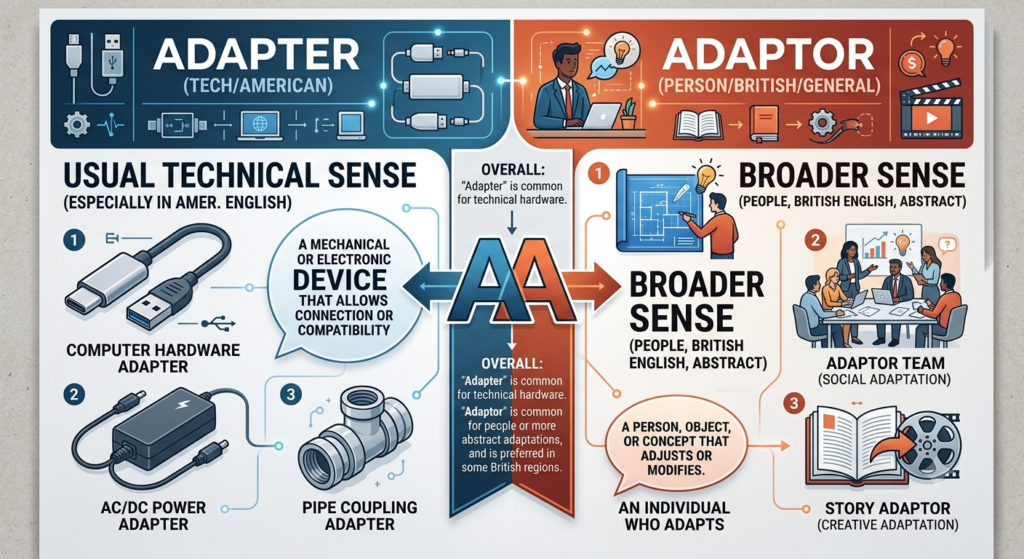
Both words describe a device or tool that lets two incompatible things work together — like a USB adapter, a plug adapter, or a network adapter card — and in casual writing, people use them interchangeably.
Does Adapter vs Adaptor Always Mean the Same Thing?
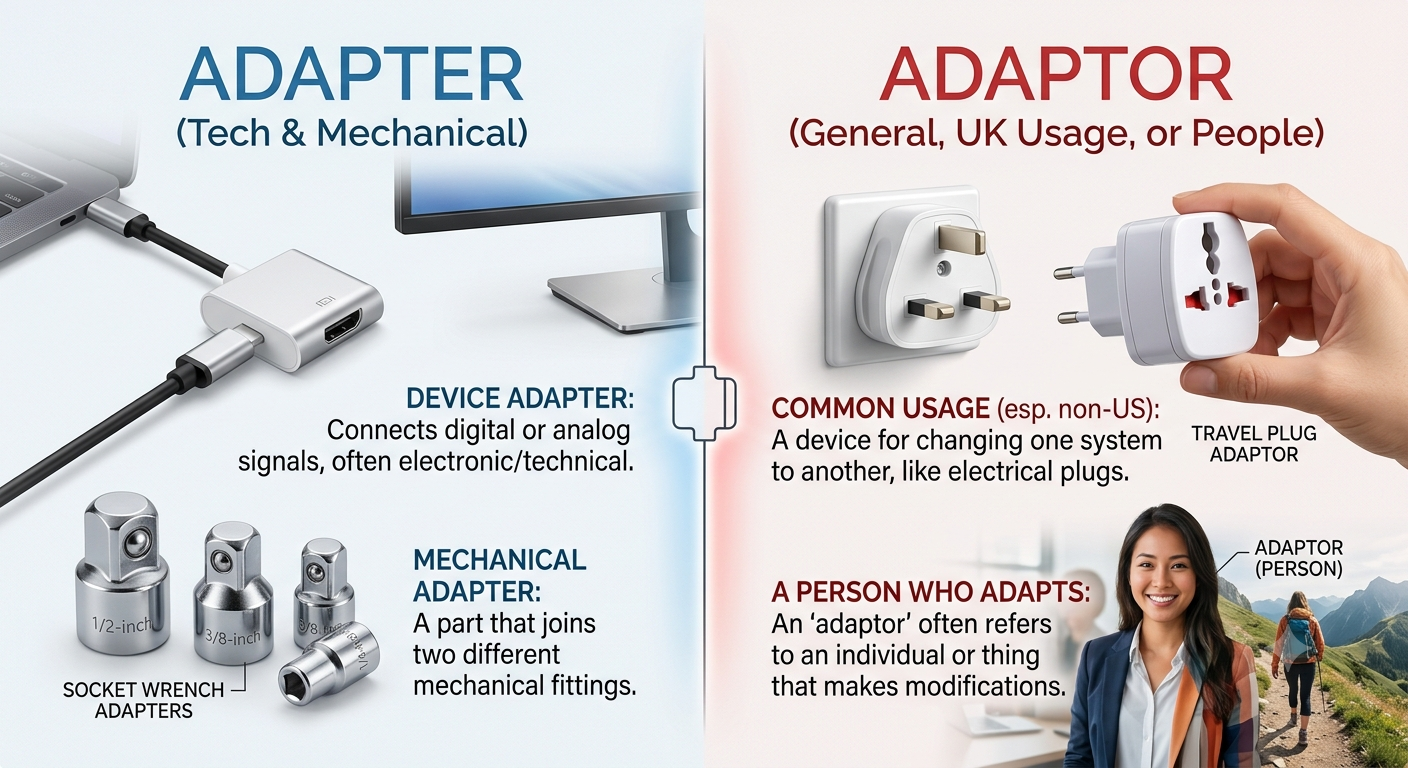
Yes, functionally. There’s no difference in meaning between the two spellings — only a difference in spelling correctness depending on the regional English dialects you’re writing for.
A USB-C adapter and a USB-C adaptor are the exact same object. The gadget doesn’t change. Only the letter before the final “-er” or “-or” changes.
Where it gets slightly more interesting is in specialized fields. In mechanical engineering terms, “adaptor” sometimes appears in older technical drawings and plumbing fittings documentation, even in American contexts, simply out of habit within that trade.
Origin of Adapter vs Adaptor Slang
Calling this “slang” is a stretch — it’s really a spelling variation rooted in word etymology — but the way people casually swap the two spellings in texts and captions does resemble how slang spreads online.
Both words trace back to the Latin adaptāre, meaning “to fit to.” From there, the term passed through French adapter before settling into English.
English has two common noun suffix patterns for turning a verb into “the thing that does the action”: -er and -or. Usually -er wins (“teacher,” “runner”), but a chunk of words borrowed more directly from Latin kept the -or ending (“actor,” “inventor”). “Adaptor” followed that older Latin-influenced pattern, while “adapter” followed the more common English -er habit.
Over time, American English leaned almost entirely toward “adapter.” British English, along with much of Commonwealth English, kept “adaptor” alive alongside “adapter,” especially for physical, plug-in objects.
Which Platforms Made It Popular?
You won’t find “adapter” or “adaptor” trending as Gen Z slang on TikTok. Instead, the spelling split gets amplified through product labeling conventions on shopping sites, consumer electronics marketing, and international shipping listings.
Search a travel adaptor on a UK retailer and “adaptor” pops up constantly. Search the same item on a US site, and “adapter” dominates. That repeated exposure through online messaging culture, reviews, and casual product chat is what keeps both spellings circulating.
Who Uses Adapter vs Adaptor the Most?
Tech companies based in the US — think Apple, Dell, and HP — almost always use “adapter” in official material.
UK retailers like Argos, along with many Australian English and Indian English speakers, are more likely to reach for “adaptor,” particularly for plug converter and travel adaptor products.
Everyday texters tend to just copy whichever spelling autocorrect or a product listing showed them last — which is exactly why both forms keep bouncing around in casual chats.
Adapter vs Adaptor vs Similar Slang Terms
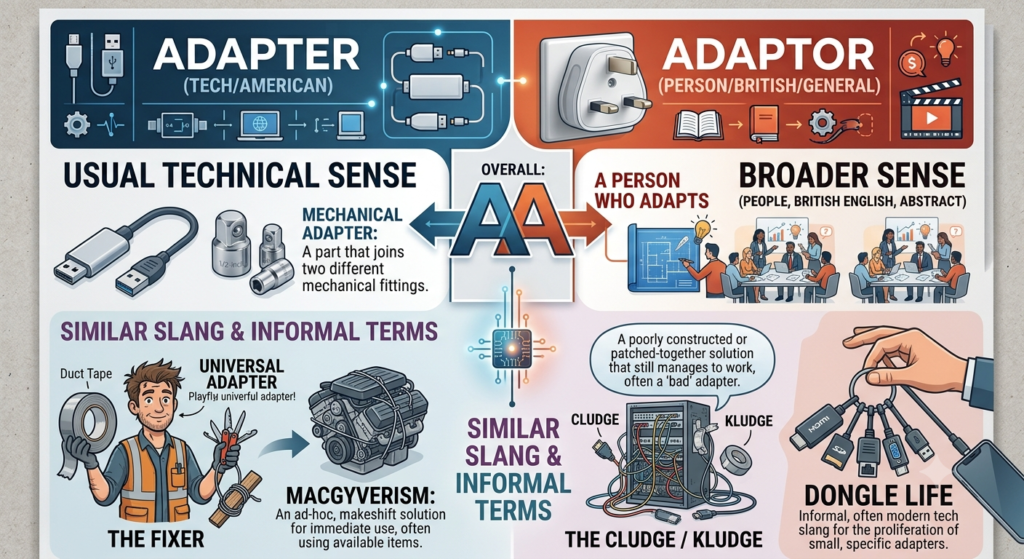
Quick Comparison Table
The table below shows how “adapter” and “adaptor” compare across usage, region, and typical products, alongside a couple of related terms people often mix up.
| Term | Common Region | Typical Use | Example Product | Dictionary Status |
|---|---|---|---|---|
| Adapter | US, Canada | General, tech | USB adapter, HDMI adapter | Preferred in Merriam-Webster |
| Adaptor | UK, Australia, India | General, physical plug items | travel adaptor, power adapter | Accepted in Oxford English Dictionary |
| Converter | Global | Changes voltage/format | voltage converter | Distinct meaning, not interchangeable |
| Adapter Card | US-leaning | Computer hardware | network adapter card, Wi-Fi adapter | Standard tech term |
Key Differences Explained
“Converter” isn’t a spelling variation of adapter or adaptor — it’s a genuinely different device. A voltage converter changes electrical voltage itself, while a plug converter or plug adapter just changes the physical shape of the plug so it fits a different socket.
That distinction matters for travelers. A travel adaptor lets your plug physically fit a foreign outlet, but it won’t protect your device if the local voltage is wrong — you’d need an actual voltage converter for that.
As for adapter versus adaptor, it comes down to style guide consistency. The AP Stylebook, used widely in American journalism, favors “adapter.” The Chicago Manual of Style generally agrees. The Cambridge English Dictionary lists both, noting regional preference.
Real Conversation Examples of Adapter vs Adaptor
Between Friends
Friend 1: “Hey do you have a spare USB-C adapter? Mine broke before my trip.” Friend 2: “Yeah I’ve got a power adapter somewhere, let me check my bag.”
Notice neither friend corrects the other’s spelling — in real texting culture, nobody cares which version you type.
In a Flirty Context
Person A: “Come over, I’ll show you my new setup 👀” Person B: “Only if you actually have a HDMI adapter this time and we’re not fighting your TV for an hour again lol”
Even in a lighthearted, flirty exchange, the word itself stays purely practical — it’s the tone around it that carries the flirtiness, not the spelling choice.
In a Group Chat
Group message: “Reminder for the trip — bring your own travel adaptor!! UK plugs are different, don’t be that person charging off someone else’s.”
Group chats planning international trips are actually one of the most common places you’ll see “adaptor” pop up in an otherwise American group, simply because the destination uses that spelling.
Is Adapter vs Adaptor Rude, Polite, or Flirty?
When It Feels Friendly
Asking to borrow a power adapter or USB adapter is about as neutral and low-stakes as a request gets. It reads as practical, not personal.
There’s no tone attached to either spelling — “Can I grab your plug adapter?” and “Can I grab your plug converter?” both land the same way: friendly and casual.
When It Can Feel Too Forward
The word itself rarely causes offense. The only real friction shows up when someone corrects another person’s spelling unprompted — “it’s spelled adaptor, not adapter” — which can come across as pedantic in a casual chat, especially since grammar myths around this topic are common and both spellings are genuinely valid.
Outside of that, there’s nothing inherently rude, polite, or flirty about either spelling on its own.
How to Respond to Adapter vs Adaptor
Simple Replies
“Sure, I’ve got one” or “Check the top drawer” cover most situations where someone’s asking about a network adapter, Wi-Fi adapter, or plug adapter.
If someone asks which spelling is correct, a simple “both work, just depends on where you are” settles it quickly.
Playful Replies
“Depends — are we going American spelling or fancy British spelling today?” works well if a friend jokingly asks which version to use.
You could also lean into the trivia: “Fun fact, it’s Latin, so technically you’re both right.”
When NOT to Use Adapter vs Adaptor
Avoid switching spellings mid-document. Formal writing, résumés, product descriptions, and technical manuals should stick to one form for SEO consistency and professionalism — pick “adapter” for US audiences or “adaptor” for UK/Commonwealth audiences and stay consistent throughout.
Also avoid using “adapter” or “adaptor” interchangeably with “converter” in technical or safety-related writing, such as aviation or automotive documentation, where precision matters and a mechanical adaptor is not the same thing as a voltage-changing device.
FAQ
Is “adapter” or “adaptor” more correct?
Neither is more correct — “adapter” is preferred in American English, while “adaptor” is common in British English and other Commonwealth English varieties.
Does Merriam-Webster recognize both spellings?
Merriam-Webster lists “adapter” as the primary American spelling, though “adaptor” appears as a recognized variant in many dictionaries.
Does the Oxford English Dictionary prefer “adaptor”?
The Oxford English Dictionary accepts both, but “adaptor” appears more frequently in British usage, especially for physical plug-in devices.
Should I use “adapter” or “adaptor” for a US audience?
For US readers, use “adapter” — it matches AP style, Chicago Manual of Style, and how companies like Apple and Dell label their products.
Is a travel adaptor the same as a voltage converter?
No — a travel adaptor just changes the plug shape to fit a different socket, while a voltage converter actually changes the electrical voltage itself.
If you found this useful, you might also enjoy a deeper look at other British-versus-American spelling pairs, like “grey vs gray” or “organise vs organize,” where the same -er/-or and regional spelling logic often applies.
Conclusion
At the end of the day, Adapter vs Adaptor isn’t really a grammar mistake waiting to happen — it’s just two valid spellings shaped by geography and history.
Use “adapter” if you’re writing for American readers, “adaptor” if you’re writing for UK or Commonwealth audiences, and don’t stress too much about it in a casual text to a friend. Either way, the plug still works.