Shown vs Showed: The Complete Guide to Getting It Right
If you’ve ever paused mid-sentence wondering whether to write “I have showed you” or “I have shown you,” you’re not alone. [Shown vs Showed] trips up native speakers and learners alike, and it shows up everywhere — texts, emails, essays, even work reports.
This confusion isn’t random. It comes from how English handles irregular verbs, and “show” happens to be one of the trickier ones.
Why People Get Confused by Shown vs Showed
Most English verbs follow a simple pattern: add “-ed” and you’re done. Walk becomes walked, talk becomes talked, no drama.
But “show” is an irregular verb, meaning it doesn’t play by that rule. Its past participle (shown) looks nothing like its simple past tense form (showed), and that mismatch is exactly where people stumble.
Add to that the fact that spoken English is often loose with grammar, and you get a habit of saying “showed” in places where “shown” actually belongs — and vice versa.
What This Article Will Help You Understand
By the end of this piece, you’ll know exactly when to use “showed” and when “shown” is correct. You’ll also see how this plays out in casual texting culture, not just formal writing, since the same words show up in DMs and group chats too.
We’ll cover the grammar rules, real examples, comparison tables, and even how people use these words in everyday digital communication.
What Does Shown vs Showed Mean in Text?
The Simple One-Line Definition
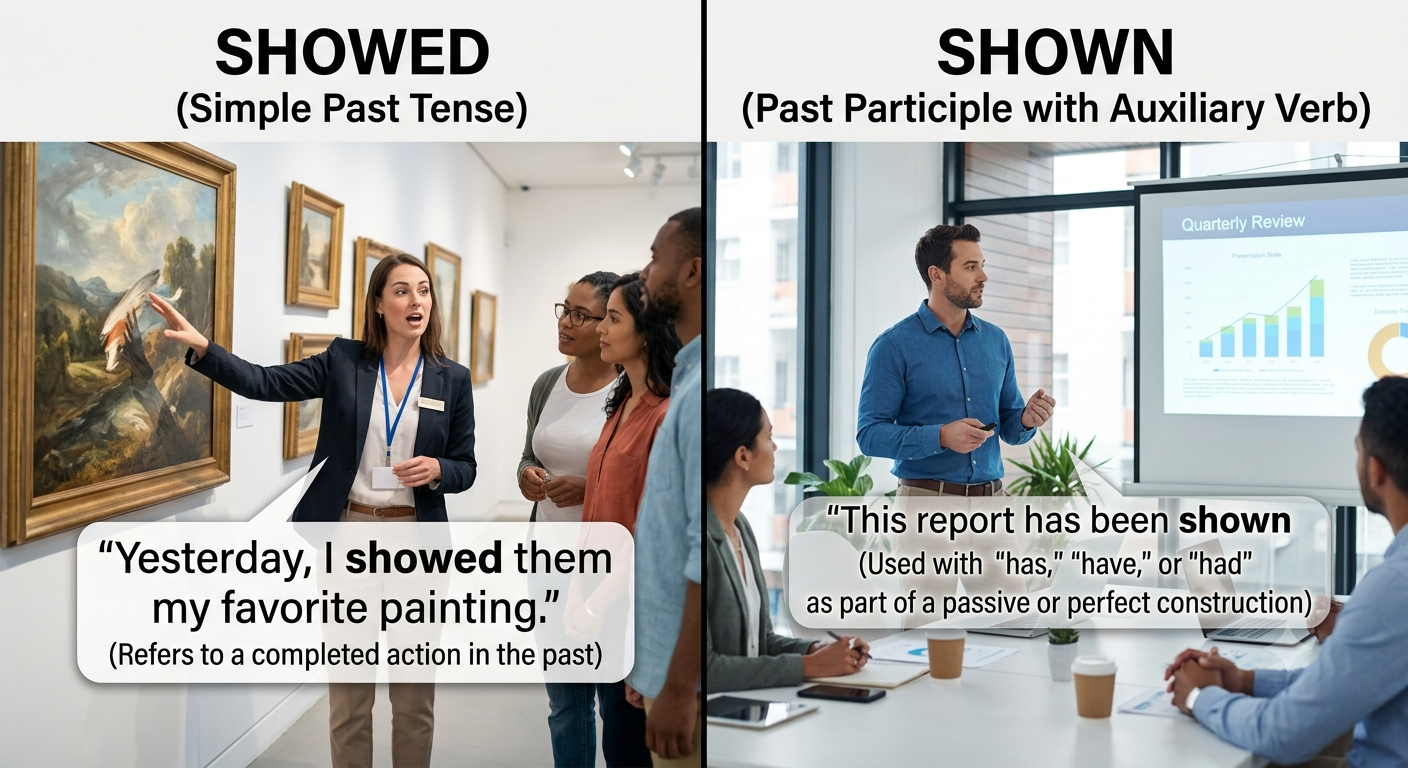
“Showed” is the simple past tense of “show,” used alone to describe a completed action — as in “She showed me the photos.” “Shown” is the past participle, which never stands alone and always needs a helping verb like has, have, had, or will have — as in “She has shown me the photos.”
Does Shown vs Showed Always Mean the Same Thing?
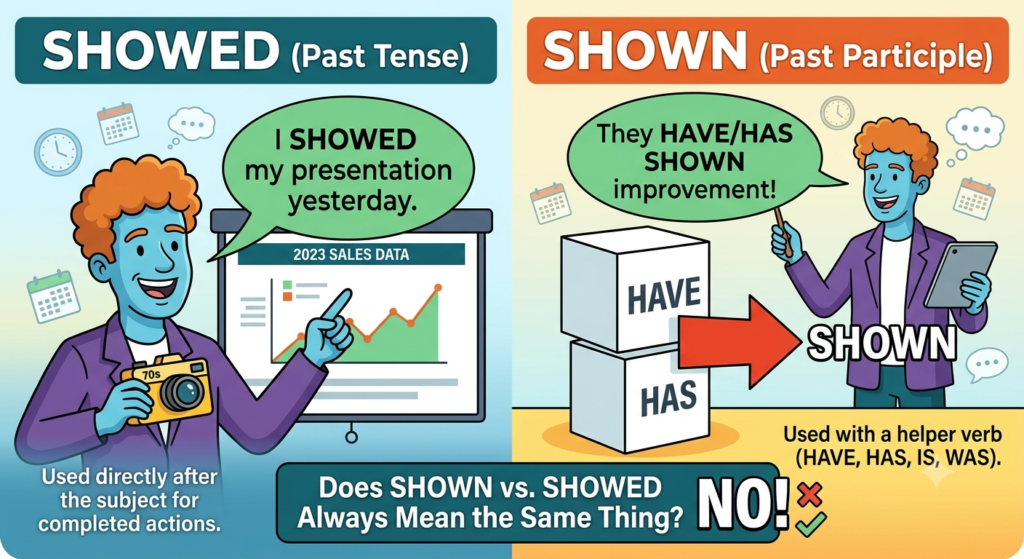
Not exactly. Both words point back to the base form of show, but they serve different grammatical jobs.
“Showed” works fine on its own in a basic sentence about the past. “Shown,” on the other hand, is built for perfect tenses — present perfect tense, past perfect tense, and future perfect tense — where it partners with an auxiliary verb.
In texting, though, people sometimes blur this line. You’ll see “shown” used loosely in casual messages even where strict English grammar rules would call for “showed,” simply because it sounds more emphatic to some texters.
Origin of Shown vs Showed Slang
“Shown” and “showed” aren’t slang in the traditional sense — they’re standard grammar terms. But their casual misuse has become its own quiet trend inside modern internet slang and casual texting language, where grammar often takes a back seat to speed and tone.
Which Platforms Made It Popular?
The mixing of “shown” and “showed” isn’t tied to one platform, but it’s especially common across Snapchat Instagram slang and WhatsApp chat words, where messages are typed fast and rarely proofread.
Short form messaging apps prioritize speed over precision, so verb forms get flattened. People aren’t trying to break grammar rules on purpose — they’re just moving quickly.
Who Uses Shown vs Showed the Most?
Younger texters, especially those active in Gen Z slang spaces, tend to mix these forms more often. It’s less about not knowing the rule and more about writing the way they’d speak out loud, where the distinction barely registers.
Professionals and writers who care about formal writing and standard English grammar are far more careful about keeping “shown” and “showed” separate, particularly in emails or reports.
Shown vs Showed vs Similar Slang Terms
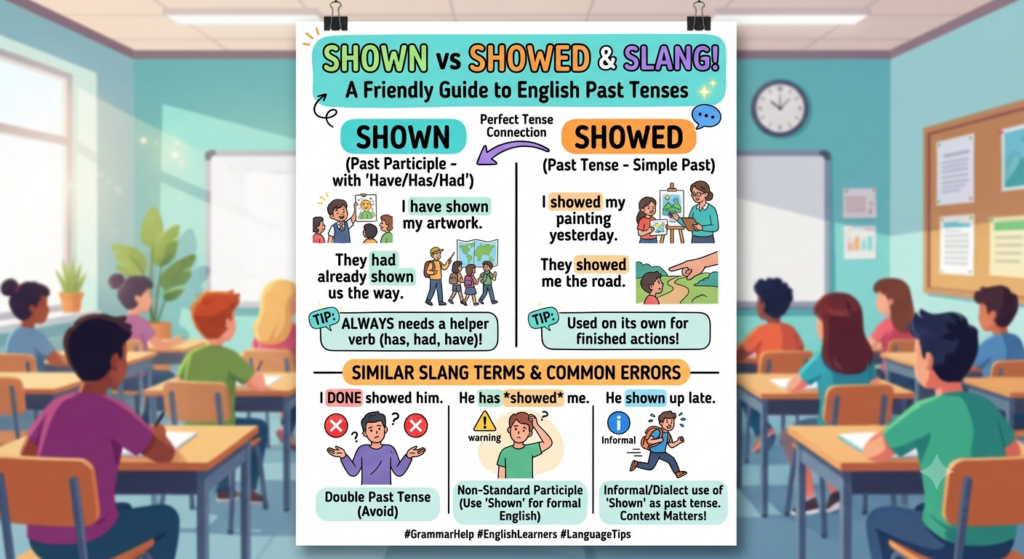
Confusion around “shown” and “showed” often overlaps with similar mix-ups involving other irregular verbs.
Quick Comparison Table
The table below shows a quick side-by-side of how “show” compares with two other commonly confused irregular verb patterns.
| Base Form | Simple Past | Past Participle | Example Sentence |
|---|---|---|---|
| Show | Showed | Shown | She has shown great patience. |
| Go | Went | Gone | He had already gone home. |
| Do | Did | Done | They have done the work. |
Key Differences Explained
Notice the pattern: go went gone and do did done follow the same logic as show, showed, shown. The simple past stands alone. The past participle always leans on a helping verb.
This is a helpful memory trick — if you can correctly use “gone” or “done,” you already understand how “shown” should behave. They’re all part of the same family of irregular verb behavior in English verb forms.
Real Conversation Examples of Shown vs Showed
Seeing these words in real messages makes the rule click faster than any textbook explanation.
Between Friends
“I showed you that video already, remember?” “Yeah you showed me last week lol.”
Here, both friends use the simple past tense correctly since they’re describing one finished action with no helping verb involved.
In a Flirty Context
“You’ve shown me more kindness than anyone else this year.” “That’s sweet, you’ve shown me a whole new side of you too.”
This is present perfect tense in action — pairing “have shown” or “has shown” to suggest an ongoing impression rather than a single moment.
In a Group Chat
“Has anyone shown Sarah the new schedule yet?” “I showed her this morning, she’s good.”
One message uses “shown” correctly with the auxiliary verb “has,” while the reply uses “showed” alone, since it’s a completed, specific action.
Shown vs Showed
When It Feels Friendly
Using “shown” correctly in a casual message, like “you’ve shown up for me so much,” reads as warm and genuine. It signals thoughtfulness without sounding stiff or overly formal.
When It Can Feel Too Forward
Overusing “shown” in emotionally loaded present perfect tense phrases — especially early in a conversation — can come across as intense. “You’ve shown me everything I ever wanted” is a lot to receive from someone you just started talking to.
Context matters more than the grammar itself here, but knowing the correct form still helps you sound intentional rather than careless.
How to Respond to Shown vs Showed
Simple Replies
If someone points out a grammar slip, a light reply works best: “Oh good catch, meant ‘shown’ there.” No need to overexplain.
If someone uses either word correctly in a message to you, a simple acknowledgment like “yeah, totally see what you mean” keeps things natural.
Playful Replies
Among friends, you can lean into the mix-up for fun: “Ok grammar police, it’s ‘shown’ not ‘showed'” said jokingly rarely lands badly, especially in a group chat setting.
Playful correction works well in casual online messaging culture, where nobody expects perfect grammar anyway.
When NOT to Use Shown vs Showed
Avoid guessing between these two in business writing grammar, academic writing style, or any professional writing tone context. A misplaced “showed” instead of “shown” in a report or cover letter can look like a careless grammar mistake, even if the rest of your writing is strong.
Also skip using “shown” without a helping verb — sentences like “I shown her the file” are a common grammar error, since “shown” can never stand alone as the main verb of a sentence.
In casual texts among close friends, the strict rule matters less, but in anything formal, get it right.
FAQ
What is the main difference between shown and showed?
“Showed” is the simple past tense and stands alone in a sentence. “Shown” is the past participle and always needs a helping verb like has, have, or had before it.
Is it correct to say “I have showed you”?
No, that’s a common grammar mistake. The correct verb conjugation is “I have shown you,” since “have” is an auxiliary verb that requires the past participle form.
Can shown ever be used without a helping verb?
No. “Shown” always requires an auxiliary verb in standard English grammar rules. Using it alone, as in “she shown me,” is considered nonstandard grammar usage.
Does British English treat shown vs showed differently from American English?
The rule itself is the same in both British English grammar and American English grammar. The difference mostly appears in how strictly each style guide enforces it in formal writing versus casual speech.
Why do people mix up shown and showed so often in texting?
Casual texting language prioritizes speed over precision, and since both words relate to the same base form of show, it’s an easy slip to make, especially in fast-paced digital communication.
Conclusion
Shown vs Showed ultimately comes down to one simple test: does the sentence need a helping verb? If yes, “shown” is your answer. If the action stands alone in the past, “showed” does the job.
Once that distinction clicks, you’ll notice it everywhere — in texts, at work, and in everyday conversation — and using the correct verb form will start to feel automatic rather than something you have to double-check.
If verb confusion like this interests you, you might also enjoy a deeper guide on other tricky irregular verbs in English.