
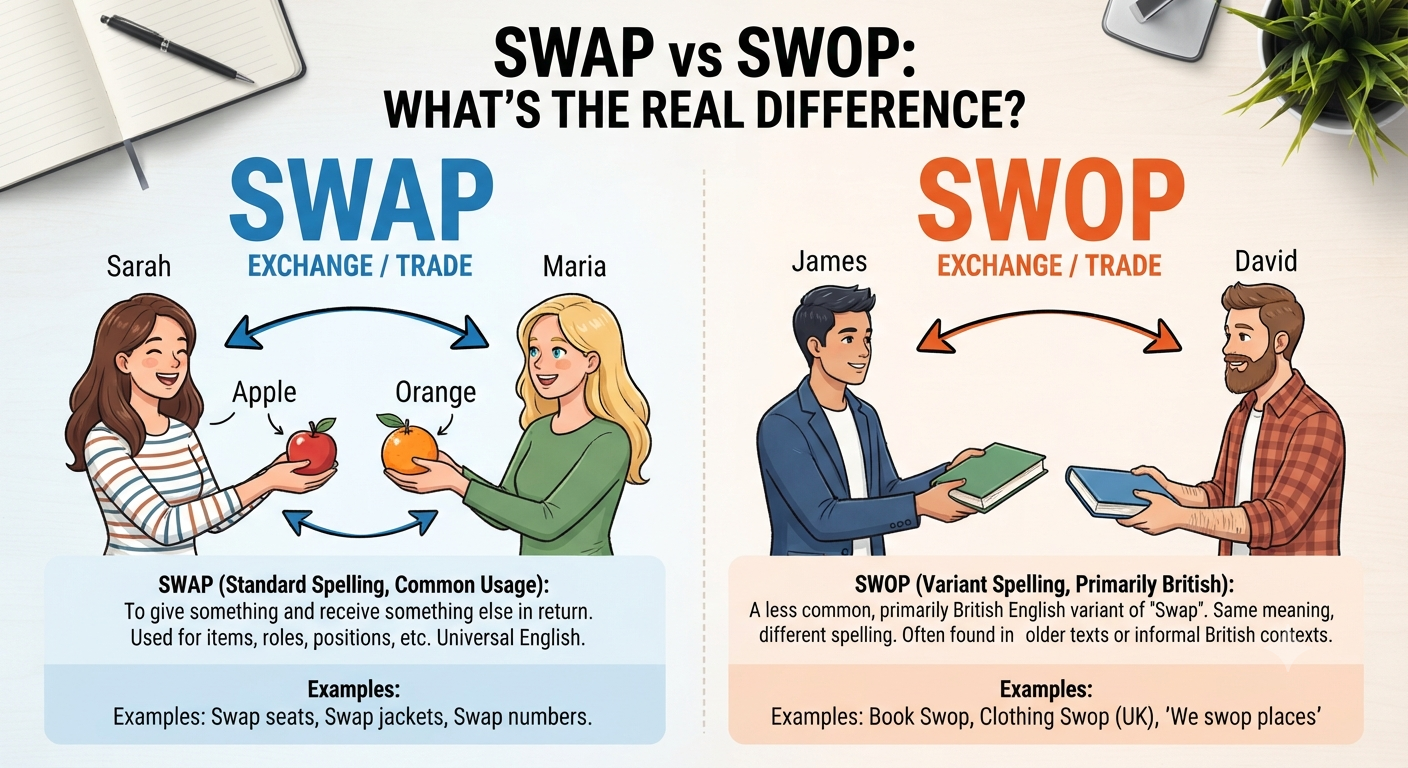
Swap vs Swop: What’s the Real Difference?
If you’ve ever typed “let’s swap numbers” and then seen someone else write “let’s swop numbers,” you’ve probably paused for a second. Which one is correct? Is one of them a typo? Is one more modern than the other?
Swap vs Swop is one of those small spelling questions that trips up a lot of people, especially when texting fast or writing on social media. The good news is that the answer is simpler than it looks once you know where each spelling comes from.
This article breaks down the Swap vs Swop definition, the swop definition, where each spelling is used, and how people actually type these words in real conversations today.
Why People Get Confused by Swap vs Swop
Part of the confusion comes from the fact that both words sound identical when spoken out loud. Nobody can hear the difference between an “a” and an “o” in casual conversation, so people default to whichever spelling looks familiar to them.
Autocorrect doesn’t help either. Depending on your phone’s language settings, it might quietly change one spelling into the other without you noticing.
What This Article Will Help You Understand
By the end of this piece, you’ll know the spelling difference between the two, which one is considered the standard spelling in modern writing, and how each version shows up in everyday texting culture, group chats, and casual messages.
What Does Swap vs Swop Mean in Text?
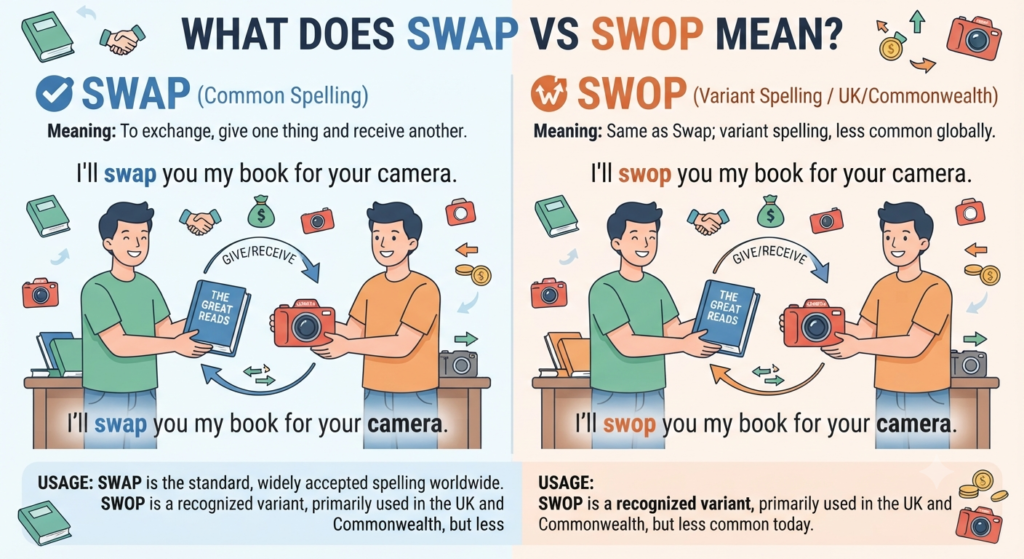
The Simple One-Line Definition
Both words mean the same thing: to exchange one thing for another. If you swap seats with a friend, you trade places with them. If someone asks to swop playlists, they want to exchange music recommendations.
There’s no hidden meaning here — this isn’t Gen Z slang with a secret second definition. It’s a straightforward exchange synonym, functioning as both a verb usage and a noun usage (“let’s do a swap” or “let’s do a swop”).
Does Swap vs Swop Always Mean the Same Thing?
Yes. According to the Oxford English Dictionary, Merriam-Webster, Cambridge Dictionary, and Collins English Dictionary, the two words are treated as spelling variants of the same word, not as separate words with different meanings.
The word meaning stays identical in every context — casual texting, formal writing, or spoken conversation. What changes is simply which letter shows up in the middle: the a or the o.
Origin of Swap vs Swop Slang
Calling this “slang” is a bit of a stretch, honestly. It’s really a case of historical spelling and dialect variation rather than internet-invented shorthand.
The word traces back to Middle English, where it originally described the sound or action of striking hands together to seal a deal — similar to how people still shake hands on an agreement today. Over time, that physical gesture of “striking a bargain” evolved into the general sense of exchanging things.
Swop appeared as a regional English dialects variant, most commonly seen in older British literature spelling, including some editions of children’s books by authors like Enid Blyton, where it was a fairly common way to spell the word.
Which Platforms Made It Popular?
Neither spelling was popularized by a specific app or platform, which sets it apart from actual modern internet slang. You won’t find “swop” trending on TikTok the way you might find a new abbreviation born on Snapchat Instagram slang culture.
That said, both spellings do appear across WhatsApp chat words, casual texting, and online messaging culture, simply because people type quickly and don’t always stop to check spelling.
Who Uses Swap vs Swop the Most?
Swap is used far more widely today, across UK English vs US English and pretty much every English-speaking region, including Australian English and New Zealand English.
Swop shows up occasionally in older UK English vs US English writing or from people who learned English through British literature spelling decades ago. It’s less common among younger writers, who tend to default to swap without a second thought.
Swap vs Swop vs Similar Slang Terms
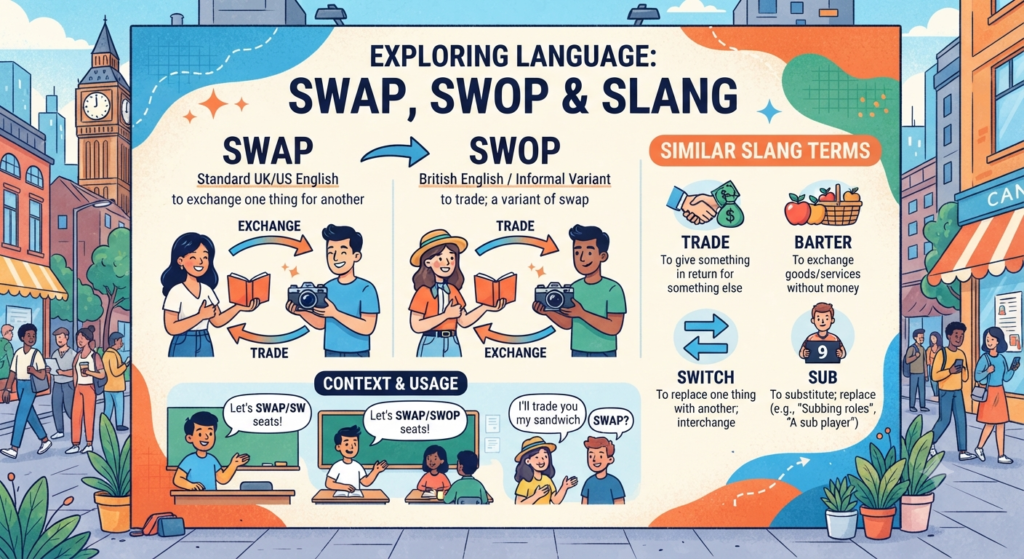
Quick Comparison Table
The table below shows how swap and swop compare to each other in terms of usage and standing in modern English.
| Feature | Swap | Swop |
|---|---|---|
| Considered standard spelling | Yes | No, considered an archaic spelling by most style guides |
| Recommended by AP Stylebook | Yes | No |
| Recommended by Chicago Manual of Short Style and Guardian Style Guide | Yes | Rarely used |
| Common in formal writing spelling | Yes | No |
| Common in casual texting | Yes | Occasionally, mostly older UK writers |
| Found in American English spelling | Yes | Almost never |
| Found in British English spelling | Yes (dominant) | Occasionally (dated) |
Key Differences Explained
The biggest difference isn’t meaning — it’s how each spelling is perceived. Swap reads as clean, current, and correct in nearly every English-language context, whether you’re in the US, UK, Australia, or anywhere else.
Swop, on the other hand, tends to read as an outdated word choice. It’s not incorrect exactly, but most English style guides now list it as a secondary or historical variant rather than a recommended one.
If you’re comparing it to true exchange synonym options like “trade” or “switch,” those words carry slightly different shades of meaning. “Trade” often implies a more formal or transactional exchange, while “swap” feels more casual and everyday.
Real Conversation Examples of Swap vs Swop
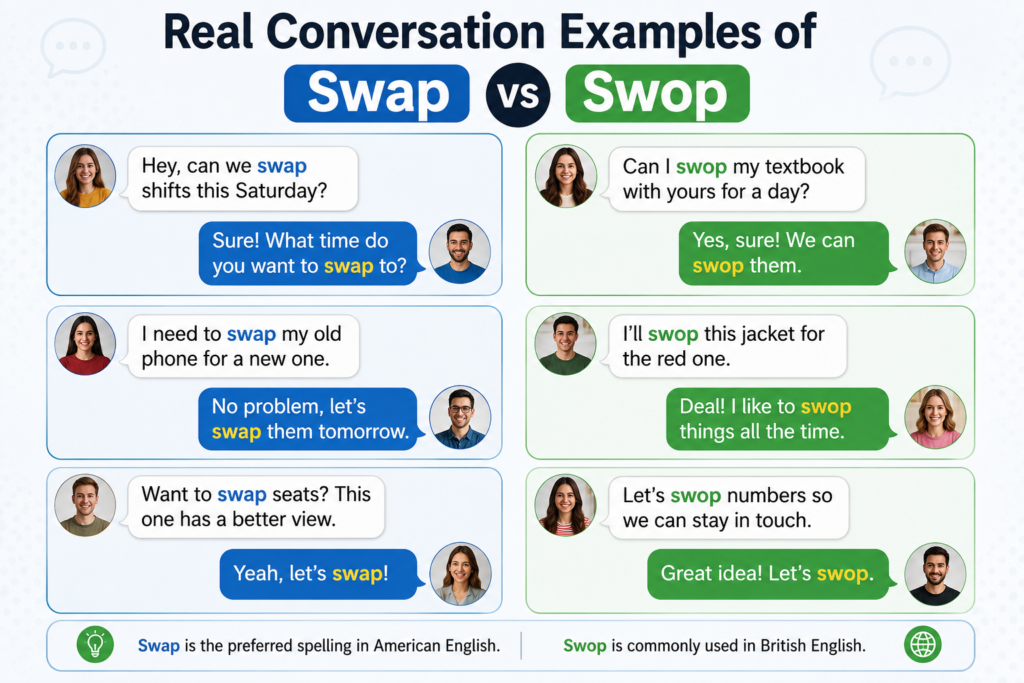
Between Friends
“Hey, can we swap seats? I want to sit by the window.” “Sure, no problem.”
This is the most common everyday use — quick, casual, and functional.
In a Flirty Context
“We should swap numbers before you leave.” “Only if you text first 😉”
Here, the word itself isn’t flirty at all — the tone comes from the surrounding message, not from choosing “swap” over “swop.” Either spelling would carry the same energy.
In a Group Chat
“Can we swap the meeting to Thursday instead? Wednesday doesn’t work for half the group.”
In professional or semi-professional group chats, swap is almost always the spelling people default to, even in relaxed conversations.
Is Swap vs Swop Rude, Polite, or Flirty?
Neither word is inherently rude, polite, or flirty on its own. The tone of a message comes from context, punctuation, emojis, and the relationship between the people texting — not from whether someone typed an “a” or an “o.”
When It Feels Friendly
Asking to “swap notes,” “swap recipes,” or “swap stories” almost always reads as warm and easygoing. It signals mutual interest without any pressure attached.
When It Can Feel Too Forward
The word itself doesn’t create that feeling — but pairing it with a request that moves too fast like asking to swap personal photos with a stranger can feel forward, regardless of which spelling is used. The discomfort comes from what’s being exchanged, not the word choice.
How to Respond to Swap vs Swop
Simple Replies
“Sure, sounds good!” “Yeah, let’s do that.” “Works for me.”
Playful Replies
“Only if you go first 😄” “Deal — but you owe me one.” “I’m in, as long as it’s a fair trade.”
When NOT to Use Swap vs Swop
Avoid using swop in professional communication, resumes, business emails, or academic writing. Most editorial standards, including the AP Stylebook and Chicago Manual of Style, favor swap as the correct spelling in formal contexts.
It’s also worth skipping swop if you’re writing for an international audience, since readers outside the UK may see it as an incorrect spelling or simply unfamiliar, which can slow down language clarity.
FAQ
Is swop a real word?
Yes, swop is a real, dictionary-recognized spelling variant of swap. It’s just far less common in modern usage and considered somewhat archaic today.
Which spelling is correct: swap or swop?
Swap is the standard spelling recommended by nearly every major dictionary and style guide, including for both British English and American English.
Is swop British English?
Swop has historically appeared more in British English spelling, though even in the UK, swap is now far more widely used across books, media, and everyday writing.
Does swap mean something different from swop in texting?
No. Both words carry the exact same word meaning in texting — to exchange something. There’s no difference in tone, meaning, or intent between the two.
Should I use swap or swop in professional writing?
Always choose swap for professional communication. It’s the version accepted by every major English style guide and won’t raise questions about correct spelling.
Conclusion
At the end of the day, Swap vs Swop isn’t really a battle between two different words . It’s one word with two spellings, and one of them(swap has simply become the accepted standard across modern English. Swop still pops up occasionally, especially in older British writing, but it won’t cause confusion either way since the meaning never changes.
If you’re texting a friend, either spelling will get the message across just fine. If you’re writing something formal, stick with swap and you’ll be safe every time.
If you found this useful, you might also enjoy a closer look at other commonly confused spelling variants in English, like “grey vs gray” or Practice vs Practise.
One Comment