
Next Friday vs This Friday: What Do They Actually Mean?
Someone texts you “let’s meet next Friday” and you immediately wonder: do they mean the Friday coming up in two days, or the one after that?
Next Friday vs This Friday is one of those tiny phrases that causes surprisingly big mix-ups. It sounds simple, but it trips up friends, coworkers, and even people writing in their native language.
This article breaks down exactly what each phrase means, why the confusion happens in the first place, and how to use both terms so nobody shows up on the wrong day.
Why People Get Confused by Next Friday vs This Friday
The confusion comes from temporal deixis — a fancy grammar term for words whose meaning depends on when they’re said.
“This Friday” and “next Friday” don’t point to fixed dates. They shift depending on your week reference point, meaning what day it is when you say them.
Add in regional English differences and American English vs British English habits, and two people can hear the exact same sentence and picture two completely different Fridays.
What This Article Will Help You Understand
By the end, you’ll know the meaning of next Friday, the meaning of this Friday, and how to use both without creating a Friday scheduling mix-up.
We’ll also cover real texting examples, a comparison table, and simple ways to clarify meeting dates so your calendar scheduling never gets messy again.
What Does Next Friday vs This Friday Mean in Text?
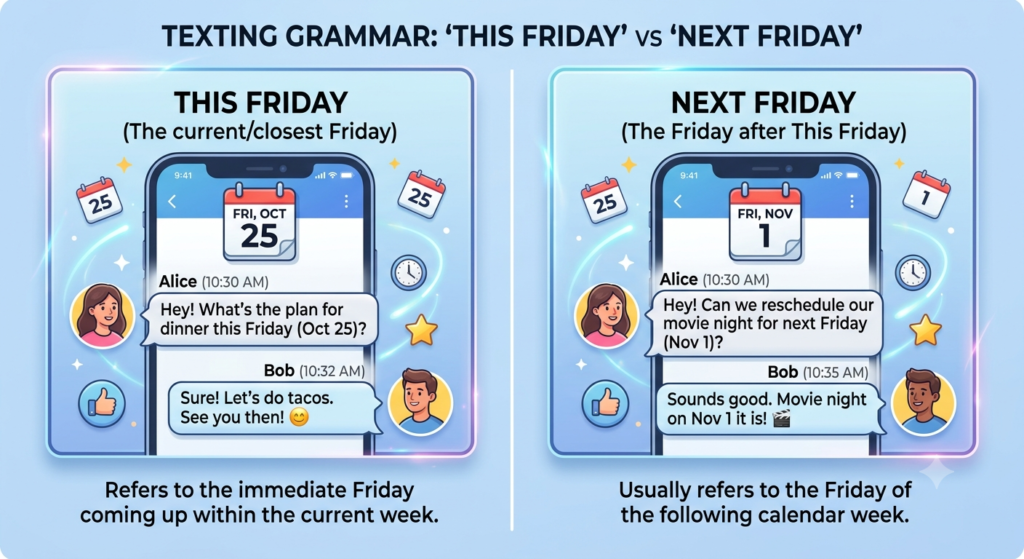
In casual texting, these phrases carry a lot of unspoken context. What one person types with total confidence can read as ambiguous scheduling language to someone else.
The Simple One-Line Definition
“This Friday” usually means the Friday of the current week — the very next one on the calendar, even if it’s tomorrow.
“Next Friday” is trickier. For many people it means the Friday of the following week, skipping over the closest one entirely.
Does Next Friday vs This Friday Always Mean the Same Thing?
No — and that’s the whole problem. If today is a Monday, most people agree that “this Friday” is four days away.
But say the same sentence on a Thursday, and “this Friday” suddenly feels like it’s just one day out, while “next Friday” might mean the one nine days from now, not two.
This is a classic deictic shift: the meaning moves depending on when in the week you’re speaking. It’s not incorrect grammar — it’s just context-dependent language doing what it does.
Origin of Next Friday vs This Friday Slang
These aren’t slang terms in the internet sense, like abbreviations born on Snapchat. They come from everyday spoken English, shaped by how people naturally talk about time.
But the confusion around them has become part of digital communication and modern internet slang culture too, especially now that so much scheduling happens over text instead of face to face.
Which Platforms Made It Popular?
You’ll see this exact debate pop up constantly in group chats, on WhatsApp chat words threads, and buried in Instagram and Snapchat slang conversations where people are casually making plans.
It also shows up heavily in texting culture around events, hangouts, and even workplace miscommunication over Slack or email, where a single word choice can shift an entire meeting.
Who Uses Next Friday vs This Friday the Most?
Younger texters using short form messaging tend to default to “this Friday” for anything happening soon, since it feels more immediate and casual.
Older generations and more formal writers, especially in professional communication, often lean on “next Friday next week” or a specific date to avoid any doubt at all.
Next Friday vs This Friday vs Similar Slang Terms
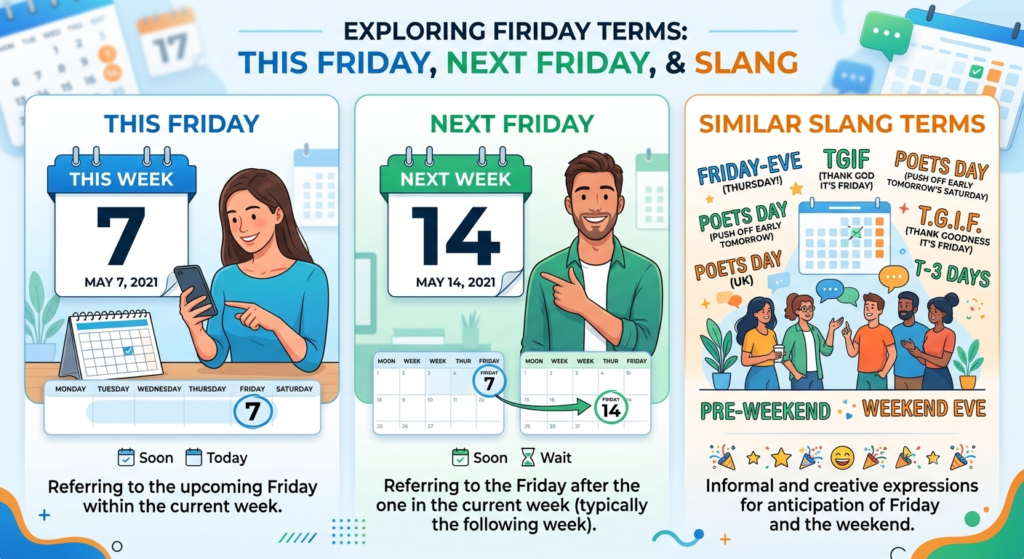
There’s a small family of time phrases that cause the same kind of confusion. Comparing them side by side makes the pattern much easier to spot.
Quick Comparison Table
The table below shows how each common phrase is typically understood, along with where the confusion usually creeps in.
| Phrase | Typical Meaning | Confusion Risk |
|---|---|---|
| This Friday | Friday of the current week | Low, unless said very late in the week |
| Next Friday | Friday of the following week (for most people) | High — some people mean the closest Friday instead |
| This coming Friday | The nearest upcoming Friday | Low, often used to clarify |
| Friday next week | Friday of the week after this one | Low, this phrase is usually the clearest |
| A week from Friday | Exactly seven days after the coming Friday | Medium, depends on when it’s said |
Key Differences Explained
“This coming Friday” is one of the safest phrases you can use, because it removes almost all the guesswork.
“Friday next week” does something similar. It anchors the listener to a specific week reference point, which is exactly why it shows up so often in business meeting scheduling.
Next Friday, on the other hand, is the loosest of the bunch. It relies on shared assumptions that don’t always match between speaker and listener.
Real Conversation Examples of Next Friday vs This Friday
Seeing these phrases in real messages makes the ambiguity click a lot faster than any definition can.
Between Friends
Friend A: “You free this Friday?” Friend B: “Yeah! Wait, this Friday as in two days, or next week?” Friend A: “Two days, sorry lol.”
In a Flirty Context
Person A: “We should grab coffee next Friday 👀” Person B: “Next Friday like tomorrow-ish, or are you making me wait a whole week?” Person A: “Making you wait, obviously. Builds anticipation.”
In a Group Chat
Sam: “Game night next Friday?” Jess: “Which Friday tho, this one or the one after” Sam: “The one after, this week is chaos for me” Mia: “Putting it in the calendar so we stop having this conversation every time”
Is Next Friday vs This Friday Rude, Polite, or Flirty?
Neither phrase is rude on its own. The tone comes entirely from context, punctuation, and who’s saying it.
When It Feels Friendly
Among friends, a quick “this Friday?” feels casual and low-pressure. It signals easy, familiar communication rather than formal email scheduling etiquette.
It’s the texting equivalent of thinking out loud, not a big ask.
When It Can Feel Too Forward
In flirtier situations, “next Friday” can carry a hint of intention, especially if it’s suggesting a date. Some people read it as confident; others might feel rushed if there’s been little conversation before it.
In workplace settings, vague phrasing can come across as careless rather than rude. It just adds friction to something that should be simple.
How to Respond to Next Friday vs This Friday
The best response usually does one job first: confirm the actual date before agreeing to anything.
Simple Replies
“Do you mean this coming Friday, the 10th, or the one after?” is direct and easy to send.
“Can you drop the actual date? Just want to make sure I put it in right” works well for professional communication too.
Playful Replies
“Next Friday as in eventually, or next Friday as in soon?” keeps things light while still asking for clarity.
“I need a date, not a vibe” is a fun way to push for specifics without sounding uptight.
When NOT to Use Next Friday vs This Friday
Skip both phrases entirely in formal emails, contracts, invitations, or anything tied to scheduling meetings with real consequences.
In these situations, use a specific date instead. Writing “Friday, July 10th” removes all doubt and prevents workplace miscommunication before it starts.
The same goes for travel bookings, appointments, or deadlines. Ambiguity might be fine in a group chat, but it’s risky anywhere money, time off, or commitments are involved.
FAQ
What does “this Friday” mean if today is Wednesday?
If today is Wednesday, “this Friday” almost always means two days from now. It refers to the Friday still inside the current week.
What does “next Friday” mean if today is Wednesday?
This is where date confusion happens most. Many people mean the Friday of the following week, about nine days away, though some still mean the closer one.
Is there a difference between US and UK usage?
Yes, somewhat. American English vs British English studies show British speakers slightly more often use “next Friday” for the nearest Friday, while many Americans push it to the following week. Neither rule is universal, though.
How do I avoid this kind of scheduling mix-up?
Use a specific date, or say “this coming Friday” and “Friday next week” instead. These phrases are far less ambiguous than “next Friday” alone.
Why does this confusion only happen with certain days?
It technically applies to any weekday, but Friday gets the spotlight because it’s tied to weekend plans. A mix-up about Friday can mean missing an entire weekend event.
Conclusion
Next Friday vs This Friday isn’t really about slang or trends — it’s a small grammar gap that everyone runs into eventually.
The safest habit is simple: whenever real plans are on the line, swap the vague phrase for an actual date. It takes five extra seconds and saves everyone a confused group chat later.
If you found this useful, you might also like a deeper guide on other common time expressions in English that cause everyday scheduling headaches.