
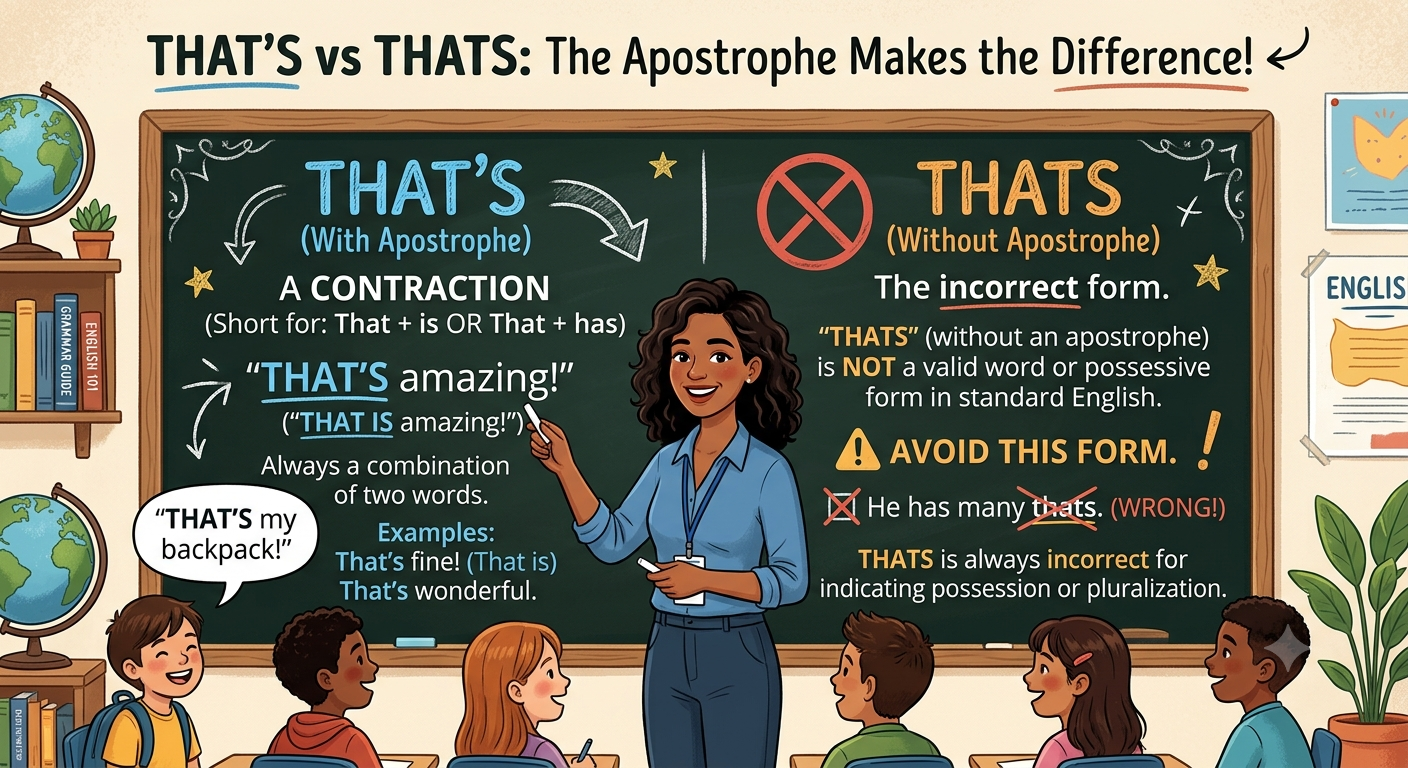
That’s or Thats: The Complete Guide to Getting It Right
If you’ve ever typed a text message and paused halfway through, wondering whether to write That’s or Thats, you’re not alone.
This tiny word trips up more people than you’d expect, especially when you’re texting fast and autocorrect isn’t paying attention.
Why People Get Confused by That’s or Thats
Most of the confusion comes down to speed. When you’re chatting on WhatsApp or replying to a group chat, you’re not stopping to think about grammar rules.
You’re just typing quickly, and the apostrophe key sometimes gets skipped entirely. This is one of the most common texting grammar slips out there, right up there with its vs it’s and your vs you’re.
Add in autocorrect errors and a phone keyboard that loves to “fix” things incorrectly, and it’s easy to see how thats ends up in messages where that’s was intended.
What This Article Will Help You Understand
By the end of this piece, you’ll know exactly when to use that’s, why thats isn’t actually a real word, and how this small detail affects everything from a casual text to a professional email.
We’ll also look at how the term shows up in digital communication, what it means depending on context, and how to reply when someone sends it to you.
What Does That’s or Thats Mean in Text?
The Simple One-Line Definition
That’s is a contraction, meaning it’s a shortened version of two words squeezed together with an apostrophe standing in for missing letters.
Thats, on the other hand, is simply that’s written without the apostrophe, and according to standard English rules, it isn’t a correct spelling at all.
Does That’s or Thats Always Mean the Same Thing?
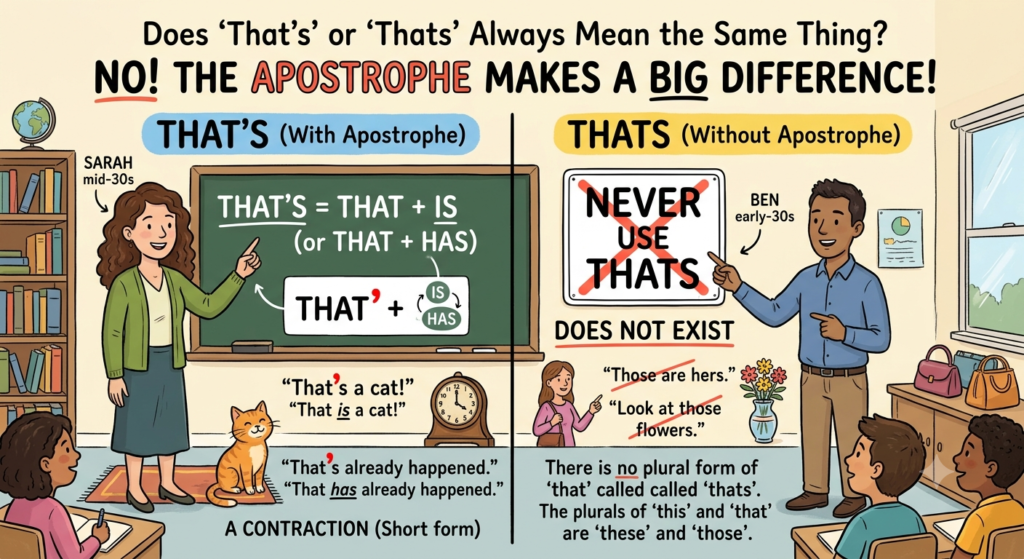
Not exactly. That’s meaning that is or that has depends entirely on the sentence it’s sitting in.
“That’s amazing” means “that is amazing.” But “that’s been a long day” actually means “that has been a long day.”
This is the contraction of that is or the contraction of that has, and both are hiding under the same three letters plus an apostrophe. Context is really the only thing that tells you which one is meant.
When people write thats without the apostrophe, that distinction gets a little murkier, though most readers can still figure out the intended meaning from the sentence around it.
Origin of That’s or Thats Slang
Which Platforms Made It Popular?
While that’s itself is standard conversational English and has been around for centuries, the casual dropped-apostrophe version, thats, really took off with modern internet slang.
Text abbreviations became the norm once phones with tiny keyboards made typing full sentences a chore. Platforms built around short form messaging, like early SMS, Snapchat Instagram slang, and fast-paced WhatsApp chat words, normalized skipping punctuation altogether.
Over time, dropping the apostrophe wasn’t seen as a mistake by most casual texters. It just became part of online messaging culture, where speed usually wins over precision.
Who Uses That’s or Thats the Most?
Younger users, especially those deep in Gen Z slang and fast-paced group chats, are the most frequent users of the apostrophe-free version.
It’s less about not knowing the rule and more about typing habits formed in casual texting language, where full sentences with correct punctuation can feel oddly formal.
Older users and anyone writing for work tend to stick closer to standard English usage, keeping the apostrophe intact even in quick messages.
That’s or Thats vs Similar Slang Terms
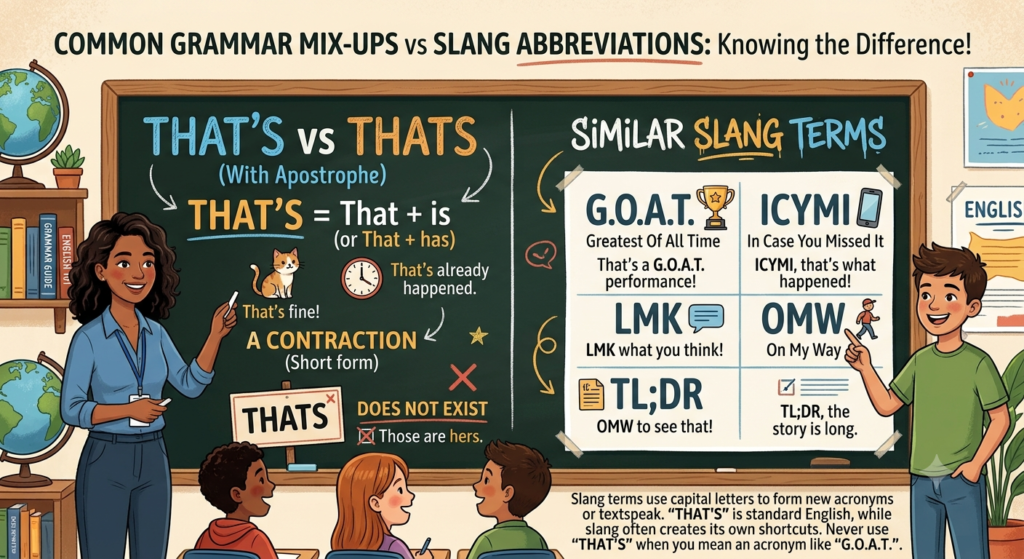
Quick Comparison Table
Here’s a simple table comparing that’s with a few other commonly confused contractions people run into during texting culture.
| Term | Correct Form | Common Mistake | Meaning |
|---|---|---|---|
| That’s | That’s | Thats | Contraction of “that is” or “that has” |
| It’s | It’s | Its | Contraction of “it is” or “it has” |
| Who’s | Who’s | Whos | Contraction of “who is” or “who has” |
| You’re | You’re | Your | Contraction of “you are” |
| They’re | They’re | Their / There | Contraction of “they are” |
Key Differences Explained
Notice a pattern here? Every one of these mix-ups involves a missing or misplaced apostrophe, and every one of them has a possessive pronoun twin that looks almost identical.
Its vs it’s is probably the most famous example, since “its” shows possession while “it’s” is short for “it is” or “it has.” The same logic applies to whose vs who’s.
This is why a quick substitution test for contractions helps so much. If you can swap the word for “that is” or “that has” and the sentence still makes sense, you need the apostrophe.
Real Conversation Examples of That’s or Thats
Between Friends
“That’s hilarious, send me the video.”
Here, the apostrophe version fits naturally into conversational English between two people who know each other well.
In a Flirty Context
“That’s cute, did you plan that outfit just for me?”
In flirty texting, that’s often carries a playful or teasing tone, showing interest without being too direct.
In a Group Chat
“Thats wild lol who told you that”
In a fast group chat, the dropped apostrophe is common and rarely raises eyebrows since everyone is typing quickly and casually.
Is That’s or Thats Rude, Polite, or Flirty?
When It Feels Friendly
On its own, that’s is neutral and often warm. “That’s so sweet of you” reads as genuinely kind, with no hidden edge to it.
When It Can Feel Too Forward
Context and tone matter a lot. “That’s none of your business” or a short, clipped “that’s it” can come across as dismissive or blunt depending on what came before it.
Punctuation, capitalization, and even response speed can shift how the same three words land in a conversation.
How to Respond to That’s or Thats
Simple Replies
“That’s true.” “Yeah, that’s fair.” “That’s exactly what I meant.”
These keep the conversation moving without overthinking things.
Playful Replies
“That’s what she said.” “Thats bold of you to say lol.” “That’s a whole mood.”
Playful replies work especially well in casual texting language among friends who already have an easy rapport.
When NOT to Use That’s or Thats
Skip the dropped apostrophe entirely in business writing credibility matters, like emails, reports, or cover letters. Professional writing tips almost always emphasize proper punctuation as a mark of care and attention.
The same goes for academic writing standards, where punctuation errors can quietly undermine an otherwise strong piece of writing.
If you’re using a grammar checker tool like Grammarly while drafting something formal, it will almost certainly flag thats as a common grammar mistake and suggest the apostrophe version instead.
FAQ
Is thats a word?
No. Is thats a word is a common search, but the honest answer is no, it’s not recognized in standard dictionaries. The correct spelling of thats is actually “that’s.”
What is the correct way to spell that’s?
The correct way to spell that’s always includes the apostrophe before the “s,” since it stands in for missing letters from “is” or “has.”
What does that’s mean in English?
That’s meaning in English depends on context, but it’s always short for either “that is” or “that has,” making it one of the most common entries on any English contractions list.
Is thats or that’s which is right?
Between thats or that’s which is right, that’s is always the grammatically correct choice. Thats is simply a spelling mistake, even though it appears constantly in casual messages.
Does Merriam-Webster recognize thats?
No. The Merriam-Webster definition only lists “that’s” as the valid contraction. You won’t find “thats” listed as an alternate or accepted spelling anywhere official.
Conclusion
At the end of the day, the debate over That’s or Thats comes down to one small apostrophe with a surprisingly big impact.
In casual texts among friends, nobody’s going to call you out for dropping it. But once sentence clarity and readability score start to matter, like in work emails or school papers, that little mark earns its place.
Keep an eye on spelling mistakes in English like this one, and your writing will read as more polished, whether you’re texting a friend or sending a message that actually counts.
If you’re curious about other everyday grammar mix-ups, you might enjoy a companion read on its vs it’s and how possessive pronouns trip up even experienced writers.

3 Comments