
Anyone Has or Anyone Have? The Full Grammar and Texting Guide
If you’ve ever typed a text and paused halfway through, wondering whether to write “anyone has” or “anyone have,” you’re not alone.
Anyone Has or Anyone Have? is one of those small grammar questions that trips up native speakers and English learners alike. It looks simple on the surface, but the confusion is real.
This article breaks it down in plain language, covers where the confusion comes from, and shows you exactly how to use it correctly in texting, emails, and everyday conversation.
Why People Get Confused by Anyone Has or Anyone Have?
The confusion usually starts with sound. “Anyone have” often just sounds more natural when spoken quickly, especially in casual speech.
Add to that the influence of texting culture, where grammar rules get bent for speed, and it’s easy to see why so many people second-guess themselves.
There’s also the fact that spoken English and written English don’t always follow the same patterns. What feels fine in a voice message might look wrong in an email.
What This Article Will Help You Understand
By the end of this guide, you’ll know the correct verb agreement rule for “anyone,” how it changes across formal writing and informal speech, and how people actually use it in real conversations.
We’ll also look at how it compares to similar phrases, how to reply when someone uses it, and when it’s best avoided entirely.
What Does Anyone Has or Anyone Have? Mean in Text?
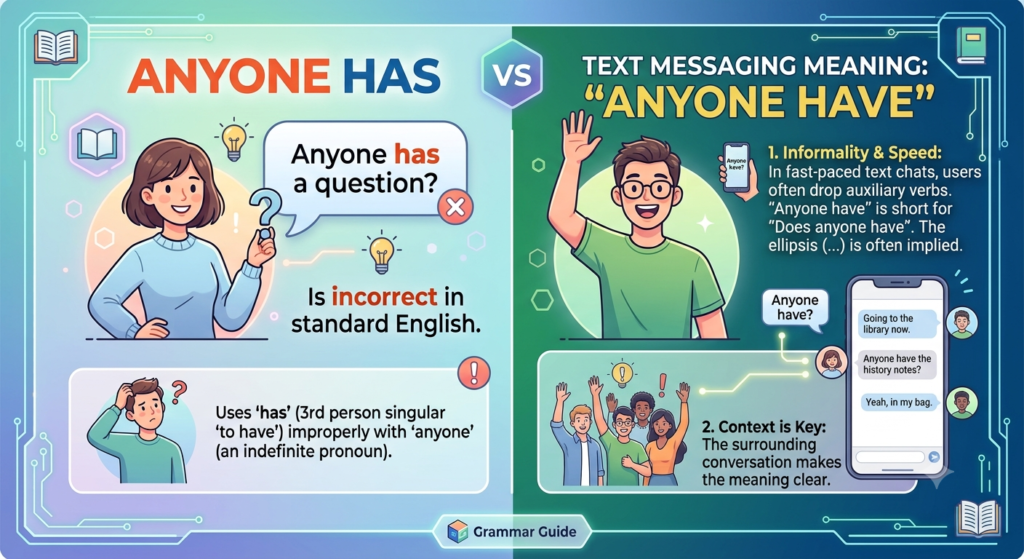
In texting and everyday messaging, “anyone has” or “anyone have” is usually used to ask if someone in a group possesses something, knows something, or is available for something.
Think of messages like “anyone have a charger?” or “does anyone have the notes from class?” These are common in group chats, WhatsApp chat words, and casual digital communication.
The Simple One-Line Definition
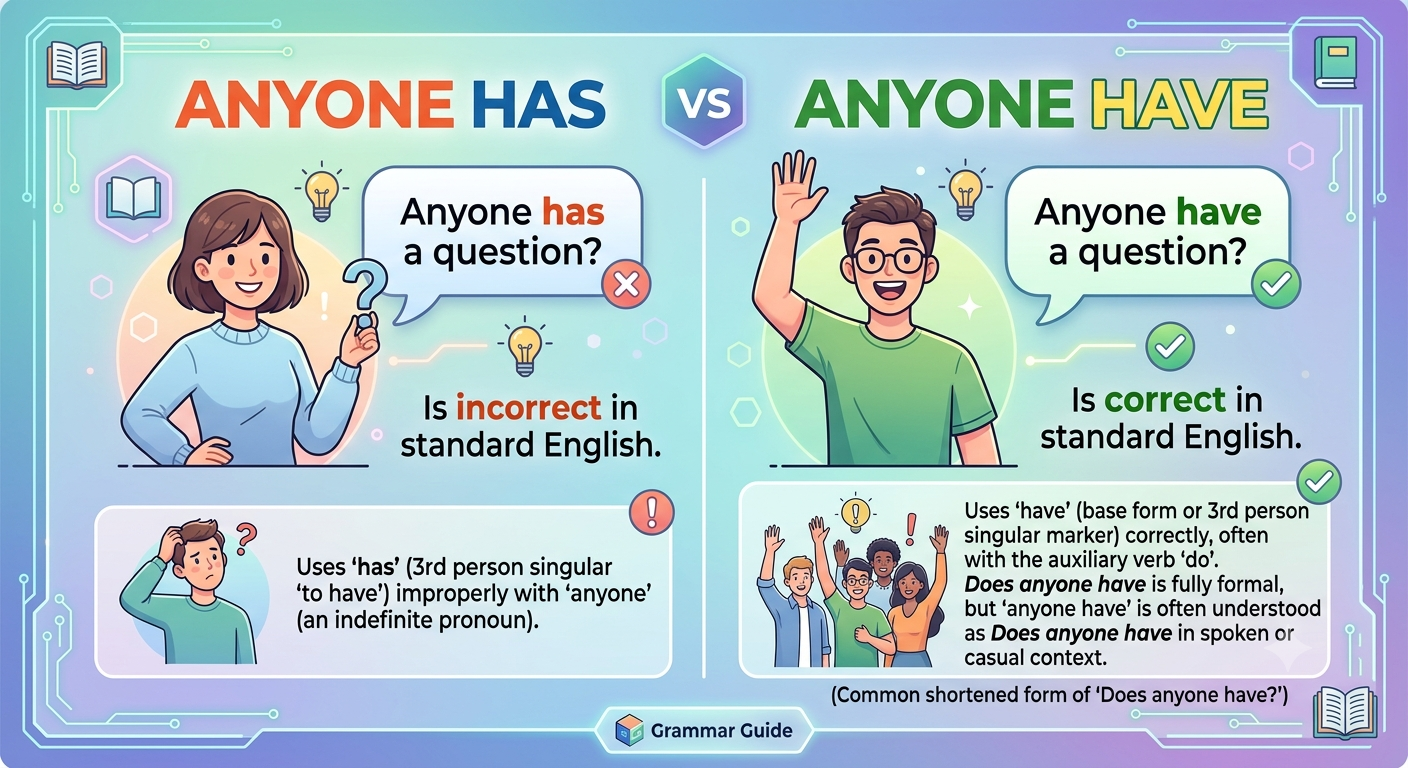
The correct grammatically correct form is “anyone has,” because “anyone” is a singular meaning pronoun and takes a singular verb agreement.
“Anyone have” is grammatically incorrect on its own, but it survives in casual speech because of how sentences get shortened in real conversation.
Does Anyone Has or Anyone Have? Always Mean the Same Thing?
Not exactly. The meaning stays the same, but the correctness depends on sentence structure.
“Does anyone have a pen?” is correct because “does” is doing the work of an auxiliary verb, allowing “have” to stay in its base form of verbs.
But “anyone have a pen?” without “does” is an elliptical question, a shortened version common in spoken English and casual texting, where the auxiliary verb is dropped but understood.
Origin of Anyone Has or Anyone Have? Slang
This isn’t really slang in the traditional sense. It’s more of a grammar shortcut that became normal through repetition in online messaging culture.
As texting replaced longer typed messages, people naturally trimmed extra words. “Does anyone have” became “anyone have,” the same way “do you want to” became “wanna.”
Which Platforms Made It Popular?
Snapchat Instagram slang, group texts, and forums all played a role. Anywhere people type fast and casually, shortcuts like this spread quickly.
Reddit threads, Discord servers, and comment sections are full of examples like “anyone have this problem too?” It’s become a normal part of modern internet slang.
Who Uses Anyone Has or Anyone Have? the Most?
Younger users, especially those active in Gen Z slang spaces, use the dropped-auxiliary version most often. It feels quick, casual, and low-effort in a good way.
Older users or people writing in professional writing tone settings tend to stick with the fully correct grammatical version, especially in emails or work chats.
Anyone Has or Anyone Have? vs Similar Slang Terms
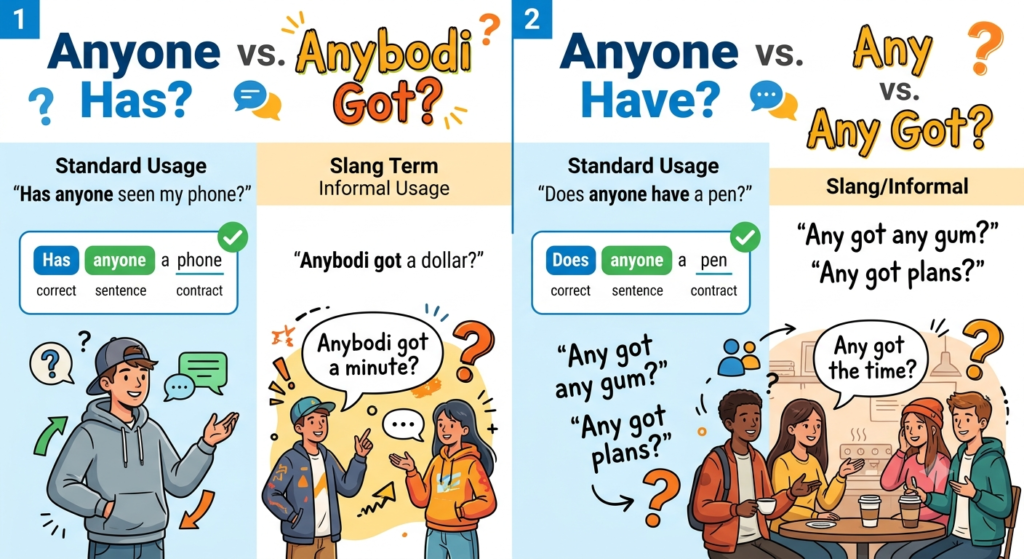
There are a handful of similar phrases that cause the same kind of hesitation. Comparing them side by side makes the pattern much easier to remember.
Quick Comparison Table
The table below shows how different indefinite pronouns pair with verbs, and whether each phrase is typically used in casual or formal contexts.
| Phrase | Correct Verb Form | Common Usage | Formality Level |
|---|---|---|---|
| Anyone has / have | has (have only after “does”) | Texting, group chats | Informal to Formal |
| Everyone has / have | has | Announcements, emails | Formal and Informal |
| Somebody has / have | has | Casual conversation | Informal |
| Nobody has / have | has | Complaints, casual talk | Informal to Formal |
| Does anyone have | have (with “does”) | Questions, requests | Informal to Formal |
Key Differences Explained
Everyone, somebody, and nobody all follow the same rule as anyone. They’re all quantifier pronouns that are treated as third person singular, so they pair with “has,” not “have.”
The exception is when “does” enters the sentence as a helping verb. Once “does” is present, the main verb drops back to its base form, which is why “does anyone have” is correct while “anyone has” stands alone correctly too.
Real Conversation Examples of Anyone Has or Anyone Have?
Seeing this phrase in real messages makes the rule click faster than any explanation. Here’s how it typically shows up.
Between Friends
“Anyone have plans this weekend?” is a common opener in a friend group chat. It’s relaxed, quick, and nobody bats an eye at the dropped “does.”
A friend might reply, “not yet, why, you thinking something?” This kind of exchange is pure conversational English, loose and unbothered by textbook rules.
In a Flirty Context
“Anyone have room for one more?” sent with a winking emoji can carry a flirty undertone, especially in a dating app message or a party invite.
The phrase works well here because it’s light and open-ended, leaving room for a playful response without sounding too direct.
In a Group Chat
“Does anyone have the Wi-Fi password?” or “anyone have the link to that doc?” are everyday examples pulled straight from short form messaging in work or friend group chats.
These messages are practical, not really about grammar at all, which is exactly why the dropped-auxiliary version feels so natural here.
Is Anyone Has or Anyone Have? Rude, Polite, or Flirty?
On its own, this phrase is neutral. It’s a request or a question, and the tone depends entirely on context, punctuation, and who’s saying it.
When It Feels Friendly
In a group chat among friends, “anyone have a phone charger?” reads as completely normal and friendly. There’s nothing rude or unusual about it.
Adding a please or a casual emoji softens it even further, keeping the tone warm and easygoing.
When It Can Feel Too Forward
In a professional setting, skipping “does” can feel a little too casual, even careless. “Anyone have the report?” sent to a work team might come across as rushed or informal.
In flirty contexts, if the phrasing is vague or repeated too often, it can start to feel like a line rather than a genuine question, which some people find off-putting.
How to Respond to Anyone Has or Anyone Have?
Responding is usually simple, but the tone of the reply can shift the whole exchange, whether you want to keep it casual or ramp up the playfulness.
Simple Replies
“Yeah, I do” or “no, sorry” cover most situations. Short, direct, and to the point, these work in almost any conversational English setting.
“I might, what do you need it for?” is another safe, neutral response that keeps the conversation moving without overthinking it.
Playful Replies
“Depends who’s asking” adds a bit of teasing energy, especially in a flirty exchange. It keeps things light while inviting more conversation.
“Maybe… what’s in it for me?” works well too, turning a simple request into a fun back-and-forth without being awkward.
When NOT to Use Anyone Has or Anyone Have?
Skip the shortened “anyone have” version in business English, formal emails, or any writing where grammatical correctness matters, like reports, resumes, or official messages.
In these situations, stick to full sentences: “Does anyone have the updated file?” or “If anyone has questions, please reach out.” This keeps your writing aligned with standard English grammar and avoids looking careless in front of a boss, client, or teacher.
It’s also worth avoiding the casual version in messages to people you don’t know well, since it can come across as too relaxed before you’ve built that kind of rapport.
FAQ
Is “anyone have” grammatically correct?
Not on its own. It’s only correct when paired with “does,” as in “does anyone have.” Without it, “anyone has” is the proper declarative sentence form.
Why do people say “anyone have” instead of “anyone has”?
It’s a natural shortcut from spoken English, where the auxiliary verb “does” gets dropped for speed, especially common in texting and casual chats.
Is this an American English vs British English difference?
Not really. Both American English vs British English treat “anyone” as singular. The variation comes from formality and speech patterns, not regional grammar rules.
Can I use “anyone have” in a formal email?
It’s best avoided. For email etiquette and professional writing tone, use “does anyone have” or “anyone has” to keep things polished and correct.
Does the same rule apply to “everyone” and “somebody”?
Yes. Everyone, somebody, and nobody all follow the same singular verb agreement rule as anyone, since they’re treated as third person singular pronouns.
Conclusion
Anyone Has or Anyone Have? comes down to one simple rule: “anyone” is singular, so “has” is correct on its own, while “have” only works when “does” is part of the sentence.
Knowing when to relax the rule for texting and when to follow it strictly for formal writing makes all the difference in sounding natural without sounding careless.
Once you spot the pattern, you’ll never second-guess it again, whether you’re texting a friend or writing a work email.
If you found this helpful, you might also enjoy a closer look at other everyday grammar mix-ups, like “everyone is” versus “everyone are,” which follows a similar logic.




3 Comments