Ourselves or Ourself? The Grammar Debate Everyone Texts About
Introduction
Ourselves or Ourself? is one of those small grammar questions that trips up way more people than you’d expect.
You’re typing a message, you pause, and suddenly you’re not sure which word looks right. It happens to native speakers just as much as learners.
This article breaks down the real grammar rule, where the confusion comes from, and how the words show up in everyday texting culture.
Why People Get Confused by Ourselves or Ourself?
Most of the confusion comes from how English handles reflexive pronouns. We’re used to “myself,” “himself,” and “herself” all ending the same way, so it feels natural to assume “ourself” should exist too.
Add in fast typing, autocorrect, and casual texting language, and it’s easy to see why people second-guess themselves mid-message.
There’s also the “royal we” effect. Kings, queens, and formal speakers have historically used “we” to refer to a single person, which makes “ourself” feel oddly correct in certain contexts.
What This Article Will Help You Understand
By the end, you’ll know the actual English grammar rule, when each word technically applies, how the words appear in real conversations, and how to respond naturally when someone uses either one.
We’ll also cover common myths, a comparison table, and a quick FAQ section for fast answers.
What Does Ourselves or Ourself Mean in Text?
The Simple One-Line Definition
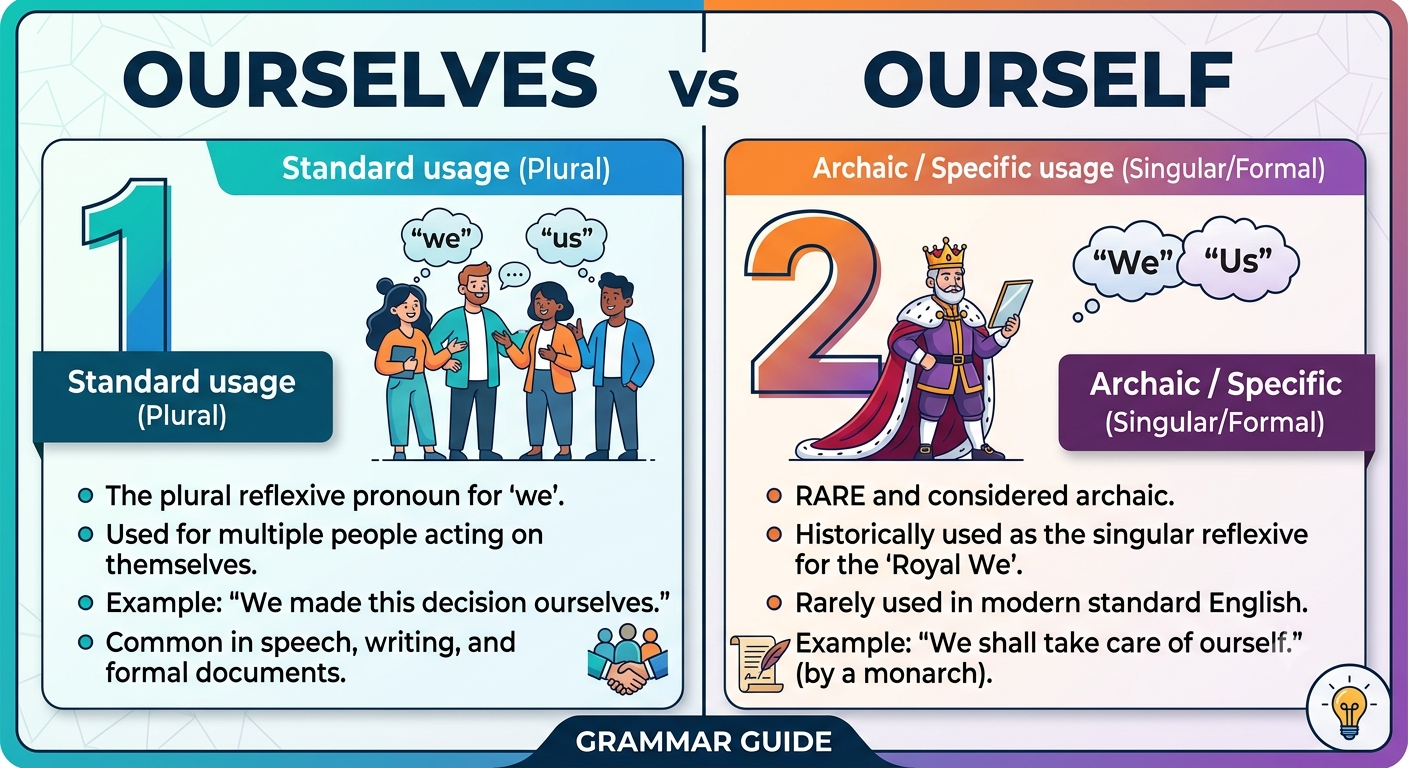
Ourselves is the standard plural reflexive pronoun, used when “we” refers to more than one person acting on themselves.
Ourself is a rare, technically singular form, used almost only with the royal we or editorial we, where one person or entity speaks as “we” but means only themselves.
In everyday modern English usage, “ourselves” is correct nearly all the time. “Ourself” is the exception, not the rule.
Does Ourselves or Ourself Always Mean the Same Thing?

Not quite. Pronoun number agreement matters here.
“Ourselves” matches with a plural subject: “We should treat ourselves to dinner.” Two or more people, one plural pronoun.
“Ourself” only fits when “we” is being used to represent a single speaker in a formal or ceremonial speech setting: “We hereby grant ourself this authority,” said in the voice of a monarch or a single institution.
Outside of that narrow lane, using “ourself” is usually treated as a grammar mistake, even though it sounds oddly formal and can feel intentional.
Origin of Ourselves or Ourself Slang
Which Platforms Made It Popular?
This one isn’t really slang in the traditional sense, like something born on TikTok or Twitter. It’s older than the internet by centuries.
The roots trace back to Old English roots and Middle English evolution, when pronoun forms were still shifting and singular versus plural reflexives weren’t fully standardized yet.
What texting culture did was expose the confusion to a much wider audience. Online messaging culture moves fast, and people don’t always pause to check which form fits, so both words now show up constantly across WhatsApp chat words, Snapchat Instagram slang, and group texts.
Who Uses Ourselves or Ourself the Most?
“Ourselves” dominates in almost every casual and formal context, from group chats to business emails.
“Ourself” shows up mostly in three places: people quoting or imitating monarchical language, writers experimenting with Shakespearean English or old-fashioned phrasing, and people who simply typed the wrong word without noticing.
You’ll rarely see “ourself” used correctly in casual texting, which is exactly why it stands out when it appears.
Ourselves vs Similar Slang Terms
Quick Comparison Table
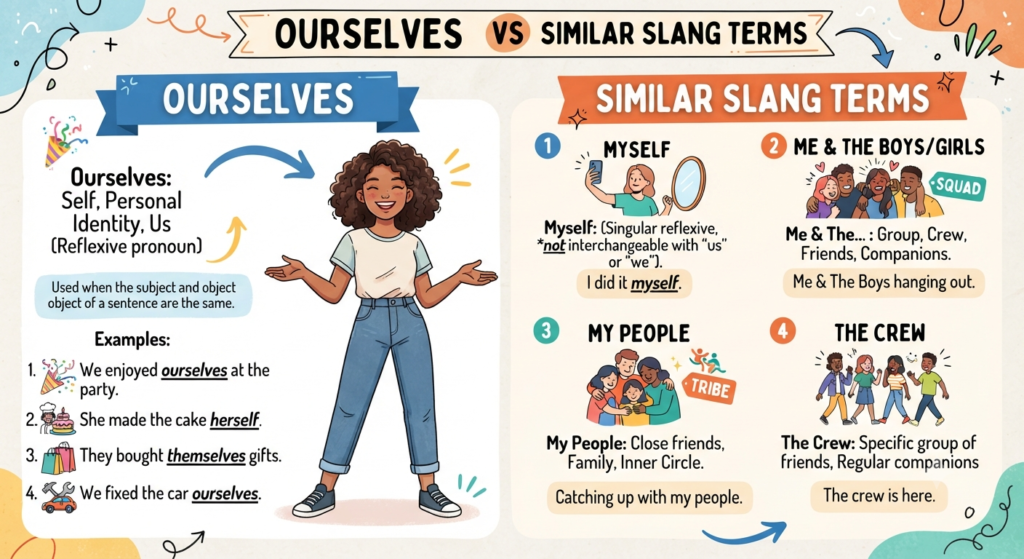
Here’s a simple breakdown comparing “ourselves” and “ourself” against a few related pronoun forms people often mix up.
| Term | Number | Common Use | Formality |
|---|---|---|---|
| Ourselves | Plural | Everyday speech, texting, writing | Neutral |
| Ourself | Singular (royal/editorial) | Ceremonial or old-fashioned speech | Very formal |
| Myself | Singular | Personal reflexive statements | Neutral |
| Themself | Singular (gender-neutral) | Modern inclusive language | Neutral to informal |
| Yourself | Singular | Direct address to one person | Neutral |
Key Differences Explained
The biggest difference is pronoun number. “Ourselves” always signals more than one person, while “ourself” signals a single speaker using “we” in a special way.
“Themself” is a helpful comparison because it shows the same pattern in reverse. It’s a singular pronoun paired with a plural-looking ending, similar to how “ourself” pairs a plural pronoun with a singular idea.
Understanding this pattern makes the whole grammar guide easier to remember, since English does this kind of pairing more than people realize.
Real Conversation Examples of Ourselves or Ourself
Between Friends
Friend 1: “We should treat ourselves to pizza tonight.” Friend 2: “Say less. We deserve it.”
This is the most common, correct, everyday use. Two people, one shared plural reflexive.
In a Flirty Context
Person A: “Maybe we should just keep this between ourselves for now 👀” Person B: “I like the sound of that.”
Here, “ourselves” adds a sense of closeness, like it’s just the two of you against the world. It’s not slang with a hidden meaning, but the word choice does add intimacy.
In a Group Chat
Group member: “Can we plan this trip ourselves instead of using an agent?” Another member: “Yes, let’s just figure it out ourselves.”
In group settings, “ourselves” reinforces that the whole group is acting together, which is exactly what the word is built for.
Is Ourselves or Ourself Rude, Polite, or Flirty?
When It Feels Friendly
“Ourselves” almost always reads as warm and inclusive. It signals teamwork, shared decisions, or shared plans, which naturally feels friendly.
Phrases like “let’s keep this between ourselves” or “we did that ourselves” carry a sense of pride or closeness rather than anything negative.
When It Can Feel Too Forward
The word itself isn’t rude, but tone and context can make it feel intense. Saying “we should just focus on ourselves” early in a new friendship or relationship might come across as presumptuous.
“Ourself,” on the other hand, can feel oddly distant or overly formal if used outside of joking or stylistic writing, since it mimics institutional we or royal speech patterns.
How to Respond to Ourselves or Ourself
Simple Replies
If someone says “we should handle this ourselves,” a simple reply like “agreed, let’s do it” or “sounds good to me” keeps things natural.
For grammar-focused conversations, something like “actually, I think it should be ‘ourselves’ here” works well if you’re gently correcting someone.
Playful Replies
If the tone is flirty or joking, replies like “I’m in, just us” or “keeping secrets already? I like it” match the energy without overexplaining.
If someone jokingly uses “ourself” in a royal tone, playing along with “as you wish, your majesty” fits the joke perfectly.
When NOT to Use Ourselves or Ourself
Avoid “ourself” in academic writing conventions, corporate writing tone, or any formal writing style unless you’re intentionally imitating royal or historical speech.
Most grammar checker tools will flag “ourself” as incorrect outside of that specific context, so it’s safer to default to “ourselves” in business writing.
Also avoid mixing the two in the same sentence or message, since that creates confusing subject-verb agreement issues and makes the sentence harder to read.
FAQ
Is “ourself” ever grammatically correct?
Yes, but only in narrow cases. It’s accepted when using the royal we or editorial we, where a single speaker refers to themselves formally.
Is “ourselves” always plural?
Almost always. It matches a plural subject like “we” when more than one person is involved in the action.
Do grammar checkers flag “ourself” as wrong?
Most grammar checker tools will flag it as an error unless the surrounding sentence clearly uses ceremonial speech or historical style.
Why do people confuse ourselves and ourself in texting?
Fast typing, autocorrect, and unfamiliarity with reflexive pronoun rules all contribute, especially since modern internet slang blends formal and informal English so casually.
Can “ourself” be used in creative writing?
Yes, it’s often used deliberately to mimic Shakespearean English or old-fashioned narration, giving dialogue a formal or majestic tone.
Conclusion
Ourselves or Ourself? really comes down to one simple rule: plural subjects use “ourselves,” and only very formal, single-speaker “we” statements use “ourself.”
Once you understand the royal we exception, the rest becomes second nature, whether you’re texting friends, writing an email, or reading old English literature.
Keep “ourselves” as your default, save “ourself” for special formal moments, and you’ll never second-guess yourself in a group chat again.
If you enjoyed untangling this one, you might also like a breakdown of “myself vs me,” another reflexive pronoun mix-up that trips people up just as often.