Quieter vs More Quiet: Which One Should You Actually Use?
If you’ve ever paused mid-sentence wondering whether to say “quieter” or “more quiet,” you’re not alone. Quieter vs More Quiet is one of those small grammar questions that trips up even confident writers and texters.
It seems simple on the surface. Yet the moment you try to explain the rule out loud, things get a little fuzzy.
This article breaks down exactly when to use each form, why both show up so often in casual texting language, and how native speakers actually talk in real life.
Why People Get Confused by Quieter vs More Quiet
English has a habit of bending its own rules. Most comparative adjectives follow a clean pattern — add “-er” to short words, use “more” before long ones.
But “quiet” sits in an awkward middle zone. It’s short enough to take “-er,” yet people still say “more quiet” constantly, especially in casual speech and online messaging culture.
That inconsistency is exactly why the confusion sticks around. You’ll hear both versions in movies, texts, and everyday conversation, so your brain never fully locks in one answer.
What This Article Will Help You Understand
By the end, you’ll know the actual grammar rule behind this comparison, when “more quiet” is technically wrong versus just informal, and how the phrase behaves differently in formal writing versus texting culture.
We’ll also look at how this comparison compares to other tricky word pairs, plus real examples from group chats and everyday conversations.
What Does Quieter vs More Quiet Mean in Text?
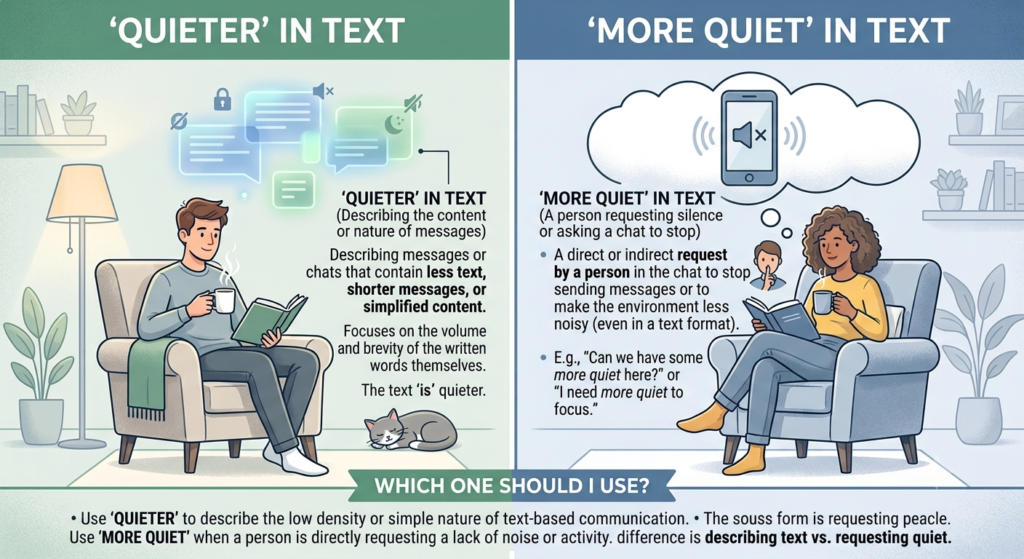
In everyday messages, both phrases mean the same basic thing: something or someone has less noise or less noisy energy than before.
The difference isn’t really about meaning — it’s about word choice and which form sounds more natural depending on context.
The Simple One-Line Definition
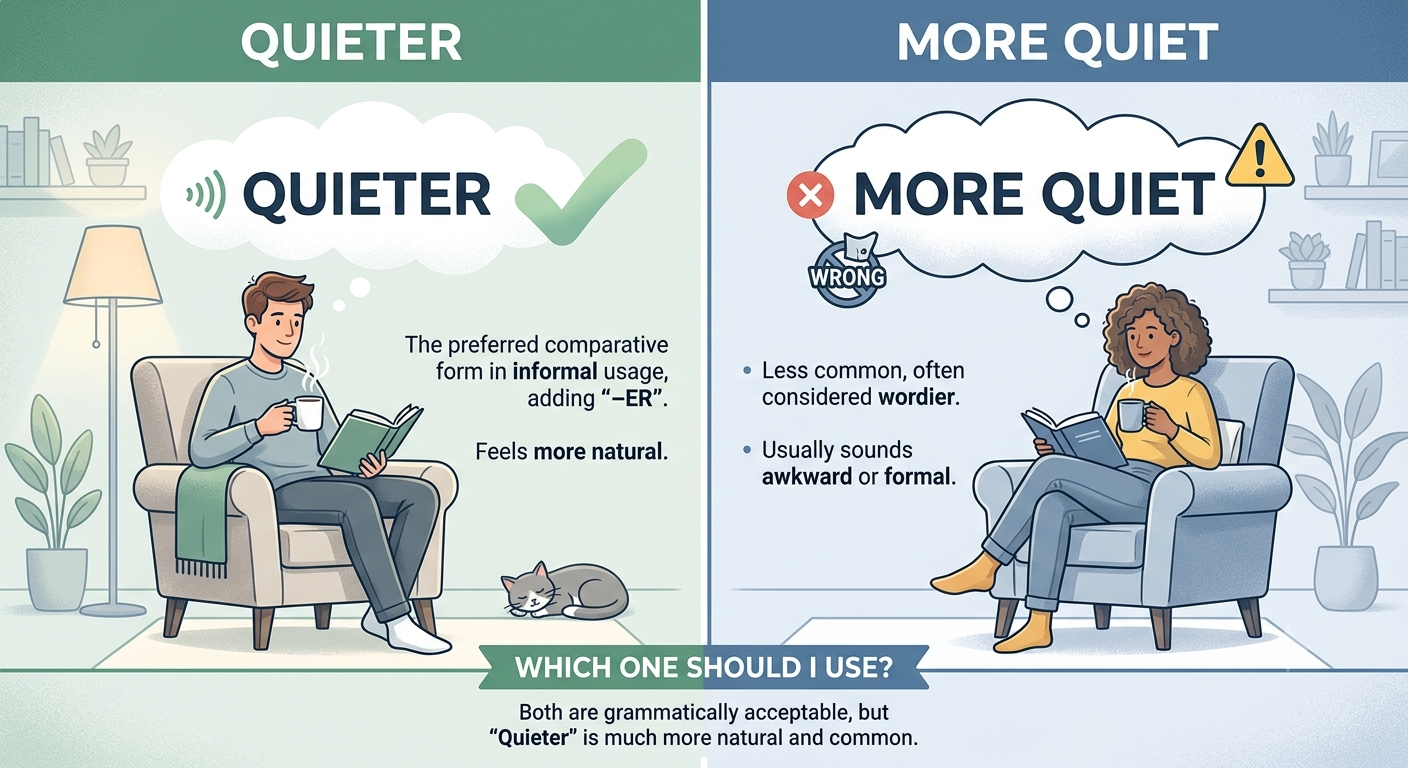
“Quieter” is the standard comparative adjective form of “quiet,” while “more quiet” is a phrase people use informally that technically breaks the syllable rule for short adjectives.
Does Quieter vs More Quiet Always Mean the Same Thing?
Mostly, yes. Whether someone texts “it’s quieter here” or “it’s more quiet here,” the listener understands the same idea: a drop in noise, or a shift toward peace and quiet.
The tone and rhythm can shift slightly, though. “More quiet” sometimes lands with a little extra emphasis, almost like the speaker is stretching the moment out for effect.
In literary writing or academic writing, this flexibility disappears. There, the standard rule takes over, and “quieter” is the expected choice almost every time.
Origin of Quieter vs More Quiet Slang
“Slang” might be a strong word here, since this isn’t a coined internet term like “bet” or “no cap.” It’s more of a grammar habit that spread through digital communication.
Still, its rise in popularity — especially the “more quiet” version — is closely tied to how people type rather than how they were taught to write.
Which Platforms Made It Popular?
Group texts, WhatsApp chat words, and quick captions on Snapchat Instagram slang style posts all favor speed over precision. When you’re typing fast, “more quiet” can feel just as natural as “quieter.”
Short form messaging apps also encourage relaxed grammar overall. Autocorrect rarely flags “more quiet” as wrong, so it keeps slipping into everyday texts unchecked.
Who Uses Quieter vs More Quiet the Most?
Younger texters raised on modern internet slang tend to use both forms interchangeably without a second thought. It’s less about Gen Z slang rules and more about typing however sounds right in the moment.
Older or more formally trained writers, meanwhile, tend to default to “quieter” out of habit, since that’s what most school grammar lessons drilled in.
Quieter vs More Quiet vs Similar Slang Terms
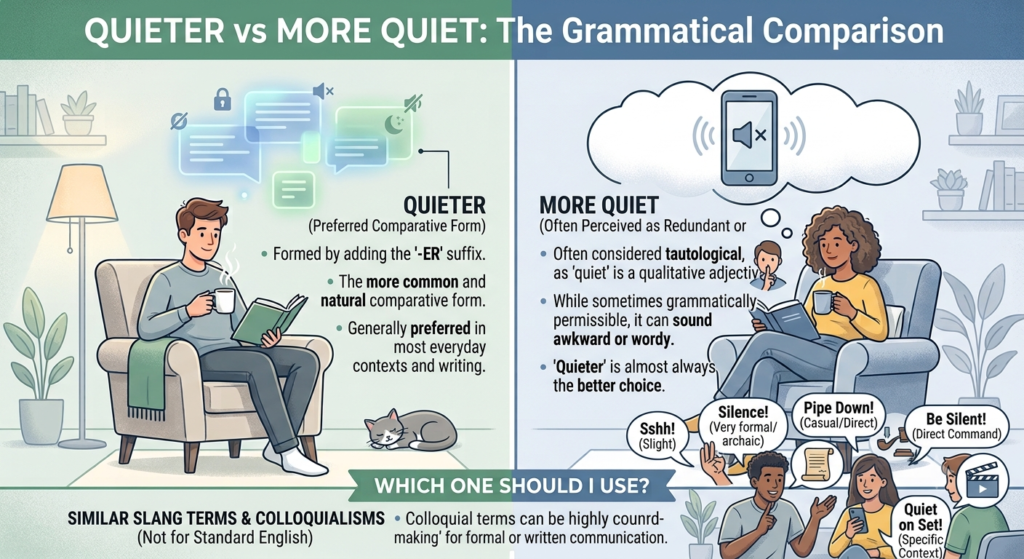
This pair isn’t alone. English has a small cluster of adjectives that cause the same “-er vs more” hesitation, and comparing them helps the rule click.
Quick Comparison Table
The table below shows how Quieter vs More Quiet stacks up against similar comparative word pairs people mix up in casual speech.
| Word Pair | Standard Form | Common Informal Form | Typical Context |
|---|---|---|---|
| Quiet | Quieter | More quiet | Texting, casual speech |
| Simple | Simpler | More simple | Everyday conversation |
| Clever | Cleverer | More clever | Spoken English |
| Narrow | Narrower | More narrow | Descriptive writing |
| Gentle | Gentler | More gentle | Casual and formal mix |
Key Differences Explained
Notice a pattern? Every word on that list is a two-syllable adjective, which is exactly the zone where English grammar gets messy.
One-syllable words almost always take “-er” (loud becomes louder, no debate). Three-syllable-plus words almost always take “more” (beautiful becomes more beautiful, never “beautifuler”).
Two-syllable words like “quiet” sit right on the fence, which is why both “quieter” and “more quiet” sound acceptable to most ears, even though only one is considered fully correct.
Real Conversation Examples of Quieter vs More Quiet
Seeing the phrase in action makes the rule easier to remember than any textbook explanation.
Between Friends
“Can we go somewhere quieter? This place is giving me a headache.”
“Yeah honestly the back patio is way more quiet, let’s move.”
In a Flirty Context
“I like it when it’s just us, it’s quieter, less noise, less distraction.”
“Same. Everything feels more quiet and calm when you’re around.”
In a Group Chat
“Guys can we keep it down, my roommate needs quiet.”
“Say less, we’ll be quieter I promise 😂”
“Lol I’ll try to be more quiet too, my bad.”
Is Quieter vs More Quiet Rude, Polite, or Flirty?
Neither version carries rudeness or flirtiness on its own. The tone comes entirely from the sentence around it, not the grammar choice itself.
When It Feels Friendly
Asking “could you be quieter, please?” or “let’s find somewhere more quiet” both read as polite, especially with a soft opener or a please attached.
When It Can Feel Too Forward
Context can shift things fast. A blunt “be quiet” without softening language can feel sharp, while “it’s nice when things get quieter, just us two” leans intimate and warm.
The grammar form barely matters here. It’s the surrounding words, punctuation, and even emoji that shape whether a message feels sweet or sharp.
How to Respond to Quieter vs More Quiet
Replies usually fall into two lanes: straightforward or a little playful.
Simple Replies
“Yeah, it’s definitely quieter now.” “True, this spot is more quiet than the last one.” “Agreed, some peace and quiet sounds good right now.”
Playful Replies
“Quieter? I thought you liked my loud energy.” “More quiet, huh, are you trying to tell me something 👀” “I’ll be as quiet as a mouse, promise.”
When NOT to Use Quieter vs More Quiet
Avoid “more quiet” in formal writing, essays, resumes, or anything reviewed by a teacher, editor, or style guide follower. The AP Stylebook and most academic standards default to “quieter.”
Skip both phrases entirely when a stronger word fits better. “Silent,” “hushed,” or “still” often carry more precision than either comparative form, especially in literary writing.
Also avoid the double comparative trap. Never combine both forms, as in “more quieter,” which breaks basic English usage and reads as a clear mistake to any native speaker.
FAQ
Is “quieter” or “more quiet” grammatically correct?
“Quieter” is the technically correct comparative adjective form based on standard grammar rule guidance. “More quiet” is common in casual speech but isn’t preferred in formal contexts.
Can I use “more quiet” in a text message?
Yes, it’s completely normal in texting. Most people won’t notice or care, since texting culture rarely follows strict sentence structure rules.
What does the Corpus of Contemporary American English say?
Data from the Corpus of Contemporary American English shows “quieter” appears far more often across both casual speech and published writing compared to “more quiet.”
Is “more quieter” ever correct?
No. That’s a double comparative, and it’s considered incorrect in every register, from casual texting language to academic writing.
Does the Oxford English Dictionary prefer one form?
The Oxford English Dictionary and Cambridge Grammar both list “quieter” as the standard comparative, treating “more quiet” as an accepted but less formal alternative.
Conclusion
At the end of the day, Quieter vs More Quiet isn’t a dramatic grammar battle. It’s a small, everyday choice that depends on your audience and setting.
Stick with “quieter” for anything formal, academic, or polished. Let “more quiet” stay where it thrives naturally, in relaxed texts and everyday chats where tone and rhythm matter more than textbook precision.
Either way, once you understand the rule behind it, you’ll never have to pause and second-guess yourself again.
If you enjoyed untangling this one, you might also like a deeper breakdown of other tricky comparative and superlative adjectives that trip up everyday writers.